
Past. Present.
Plug in.
The three-bullet case for Emotional Dynamics.

The three-bullet case for Emotional Dynamics.
From sentiment to Emotional Dynamics
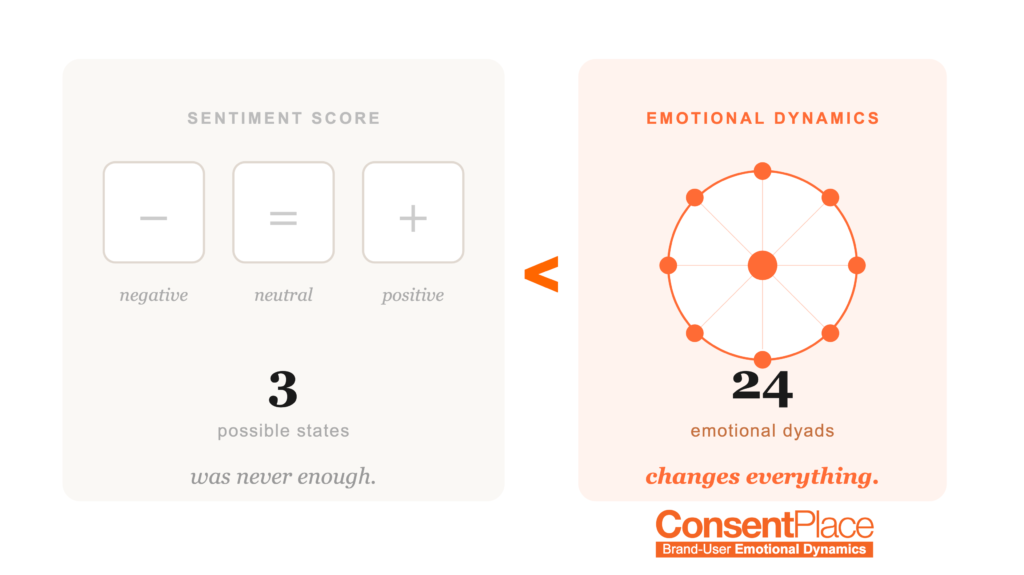
Sentiment analysis was a reasonable answer to an early question: can a machine tell if a customer is happy or unhappy? The answer was yes — roughly. Positive, negative, neutral. A traffic light. Good enough for a decade of dashboards.
The problem is that human beings do not feel in three states. They feel in spectrums, in contradictions, in compounds. A customer who is simultaneously hopeful and afraid is not “neutral.” A customer who is joyful but suspicious is not simply “positive.” And a customer in Remorse — recoverable, still reachable — is not the same as a customer in Contempt, who has already decided to leave and is just waiting for the exit door.
Positive / Neutral / Negative
8 primaries · 24 dyads · real time
Emotional Dynamics are the present. Not a score after the fact. Not a survey the customer fills in three days later. A continuous reading of what people actually feel — turn by turn, conversation by conversation — and where that feeling is heading.
Emotional Dynamics is the answer.
The shift is not incremental. It is categorical. Sentiment tells you a customer is unhappy. Emotional Dynamics tells you they are in Cynicism — which means the relationship is functionally over — versus Remorse, which means a single well-timed intervention can reverse it. That distinction is the difference between spending a retention budget on customers you cannot save and spending it on the ones you still can.
Grounded in world-established science
This is not a proprietary framework invented by a startup in 2024. It is the application of forty-six years of peer-reviewed psychoevolutionary science to the brand-user conversation problem.
Robert Plutchik’s model of emotion — published in 1980, developed through 2001 — established that human emotional experience is structurally organized. Eight primary emotions. Twenty-four dyads formed by their combination. A spatial relationship between states that predicts behavior with measurable accuracy.
On April 2, 2026, Anthropic’s interpretability team published research confirming that large language models develop functional emotional representations organized in a structure that — and this is their finding, not ours — echoes Plutchik’s spatial model. The model didn’t learn emotion from a diagram. It absorbed it from forty years of humans writing about how they feel. And the structure that emerged is the structure Plutchik mapped.
This matters because it validates the architectural choice ConsentPlace made from the first line of code. We built on Plutchik not because it was convenient, but because it is the most rigorously validated framework for human emotional experience that exists. The science was always sound. Now it is confirmed inside the machines themselves.
The three KPIs that emerge from this foundation — Love Dyad Percentage (LDP), Emotional Churn Indicator (ECI), and Dyad Shift Rate (DSR) — are not abstract measurements. They are the operational layer that turns Plutchik’s science into business decisions: when to intervene, how to intervene, and whether the intervention worked.
Integration is effortless
The most common objection to any new intelligence layer is the same: “We’d love to, but our stack is complex and we can’t afford a rip-and-replace.”
ConsentPlaceAgent was designed specifically for this reality. It does not replace your existing AI. It does not require a migration, a retraining cycle, or a new interface for your team. It plugs into what you already have — in three lines of code — and starts returning emotional signals immediately.
POST /v1/analyze
{
“message”: “[user message]”,
“context”: “[conversation history]”
}
// Returns 8 emotional signals in JSON
→ primary_emotion · dyad · valence
→ arousal · pattern · topic_risk
→ playbook · consent_timing
Your system decides what to do with those eight signals. Route to a different response. Trigger a SmartBrief alert. Flag the conversation for human review. Fire the consent request at the optimal emotional moment. The intelligence is ours. The decision is yours.
Emotional Dynamics, live across every conversation, today. No rip-and-replace. No waiting. No excuses.
Past. Present. Plug in.
ConsentPlaceAgent is live. Three lines of code. No rip-and-replace.
Contact Us →References & Sources
- Plutchik, R. (1980). “A general psychoevolutionary theory of emotion.”
- Plutchik, R. (2001). “The Nature of Emotions.” American Scientist, 89(4), 344–350.
- Anthropic Interpretability Team (April 2, 2026). Emotion concepts and their function in a large language model. — “Measuring emotion vector activation during deployment could serve as an early warning that the model is poised to express misaligned behavior.”
- Deloitte (2025). Brands above 15% Love Dyad grow 2.2× faster than competitors.
- Zendesk CX Trends Report (2025). 73% of consumers switch brands after repeated poor experiences. 32% abandon even loved brands after a single bad interaction.
- Frontiers in Psychology (2025). Global Emotional Intelligence Decline 2019–2024. Global emotional intelligence has declined 5.79% since 2019.
- Bain & Company + Altagamma (2025). Global Luxury Market Report. 50 million consumers exited luxury brands in 2024.
- Anthropic Just Proved Why ConsentPlace’s Emotional Dynamics Is Not Optional — ConsentPlace Blog, April 2026.
- ConsentPlaceAgent Is Live. Your AI Just Got a Nervous System. — ConsentPlace Blog, April 2026.
- The customer didn’t complain. Didn’t escalate. Just quietly decided to leave.
- How to Measure Emotional Dynamics ROI: The 3 Metrics That Matter. — ConsentPlace Blog, March 2026.
- The Emotional Recession Is Here. — ConsentPlace Blog, March 2026.
2 comments