
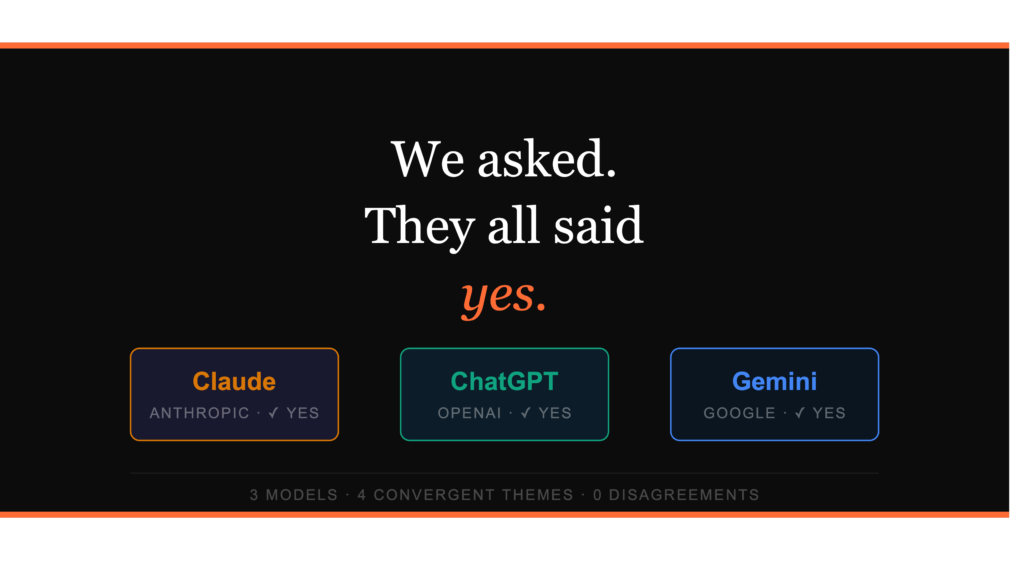
We asked Claude, ChatGPT, and Gemini the same question.
They all gave the same answer.
“Is ConsentPlace’s Emotional Dynamics a good idea?” Three honest bullet points. Three AIs. Zero disagreement.
We gave three frontier AI models — Claude, ChatGPT, and Gemini — the same prompt, with no additional context, no instructions on what to say, and no knowledge of each other’s answers.
All three said yes. And all three explained why in the same words: the gap is real, the science is defensible, and the business outcomes are measurable. When the machines that could compete with ConsentPlace validate it instead — that is not a pitch. That is a consensus.
One prompt. No context. No coaching.
The question was simple — and deliberately neutral. We did not ask the models to validate ConsentPlace. We did not provide background material. We did not frame the answer. We asked whether the idea was good and why, in three honest bullet points, and stepped back.
Three models. Three companies. Three independent architectures. The answers below are verbatim — unedited, in the order they were received. What happened next is the most credible validation ConsentPlace has ever received.
We did not ask them to agree. We did not tell them what to say. And yet — across three entirely independent architectures — the same four themes emerged, word for word, with no coordination.
| Theme | Claude | ChatGPT | Gemini |
|---|---|---|---|
| The gap is real — and growing | ✓ | ✓ | ✓ |
| The science is defensible (Plutchik) | ✓ | ✓ | ✓ |
| Business outcomes are measurable | ✓ | ✓ | ✓ |
| The category is unclaimed | ✓ | ✓ | ✓ |
Claude names it explicitly: “prescriptive AI for conversational agents is an unclaimed category.” ChatGPT frames it as a missing layer. Gemini calls it emotional blindness. Different words, identical diagnosis.
What it means when your competitors validate you
Claude is built by Anthropic — the same company whose April 2026 interpretability paper independently confirmed that LLMs develop emotional representations consistent with Plutchik’s model. ChatGPT is OpenAI’s flagship product. Gemini is Google’s. These are not neutral observers. They are the companies building the platforms that ConsentPlaceAgent runs on top of.
And all three said the same thing: the gap is real, the science holds, the business case is clear, and the category is open.
We didn’t ask them to agree.
We didn’t tell them what to say.
We asked them if it was a good idea.
They all said yes — and explained why in the same words.
Notice what ChatGPT added, unprompted: “enterprises won’t buy ’24 emotional dyads’; they’ll buy higher conversion, lower churn, better customer experience, and stronger consent rates.” That is not a description of ConsentPlace’s technology. That is a description of ConsentPlace’s sales pitch — written by a competitor’s model, without being asked.
Notice what Gemini added, also unprompted: the exact Playbook Routing logic that is capability 07 of ConsentPlaceAgent — “Pattern: Hesitation. Next move: Minimum data ask. Avoid: Push for commitment.” That is not a description of what the system should do. That is a description of what the system already does.
This is what independent validation looks like when the science is right. Not a press release. Not a customer quote. Three machines that process more language per day than any human analyst — asked a neutral question, given no instructions — converging on the same answer from three different directions.
ConsentPlaceAgent is live. Built on Plutchik’s 50-year model. Confirmed inside LLMs by Anthropic. Validated by ChatGPT and Gemini. Three lines of code on your existing stack.
The machines agree. The question is whether you act first.
ConsentPlaceAgent is live. GDPR-native. Built on Plutchik. Three lines of code. No rip-and-replace.
Contact Us →References & Sources
- Claude (Anthropic), ChatGPT (OpenAI), Gemini (Google) — responses to the prompt “Is ConsentPlace’s Emotional Dynamics a good idea and why in 3 short honest bullet points.” June 2026. Verbatim, unedited.
- Anthropic Interpretability Team (April 2, 2026). Emotion concepts and their function in a large language model. LLMs independently develop emotional representations consistent with Plutchik’s psychoevolutionary model.
- Plutchik, R. (1980). “A general psychoevolutionary theory of emotion.” — (2001). “The Nature of Emotions.” American Scientist, 89(4), 344–350.
- A/B test: A/ proved engagement is possible. B/ proved loyalty is buildable. — ConsentPlace Blog, June 2026.
- ConsentPlaceAgent’s 8 Emotional Dynamics Instruments — ConsentPlace Blog, May 2026.
- The customer didn’t complain. Didn’t escalate. Just quietly decided to leave. — ConsentPlace Blog, May 2026.
- Anthropic Just Proved Why ConsentPlace’s Emotional Dynamics Is Not Optional — ConsentPlace Blog, April 2026.