
“Yes” Is Not a Yes Forever.
An initial “yes” cannot answer every question about what an AI system is allowed to do—or how it should behave next.
What does your “yes” actually cover?
Agreement
What has the person knowingly agreed to?
Permissibility
Is the intended AI use allowed under the applicable rules?
Behavior
How does the agent respond as the person’s needs change?
“The user consented.” Then what?
It is an easy sentence to reach for in a product meeting. The user accepted the terms, enabled personalization, or chose to continue with an AI assistant. The team has recorded an affirmative action. The interaction proceeds.
But that first agreement cannot settle every subsequent decision. What happens when the person becomes confused? When they reveal a financial difficulty? When they say, “Actually, I’m not sure”?
For a company called ConsentPlace, this distinction matters. Consent deserves precision. Treating it as blanket permission weakens the very idea it is meant to protect.
Agreement and permissibility are different questions
Consent does not override an applicable AI Act prohibition. Article 5 sets boundaries for specified practices; collecting an agreement does not, by itself, move a prohibited use outside those boundaries. [1]
Teams therefore need to examine what the system does, who it affects, and the context of use. An acceptance screen cannot substitute for that assessment.
It also helps to keep disclosure and agreement distinct. Telling someone they are interacting with AI provides information. Asking them to accept a particular use seeks agreement. Neither action alone establishes that every later system behavior is appropriate.
A person’s first “yes” does not tell you what your AI should do with their next “I’m not sure.”
Three moments where ConsentPlace changes the conversation
The difference becomes tangible when you examine what happens after a customer starts engaging. In the supplied ConsentPlace demonstration, the customer raises a cost concern, discloses losing their job, and then asks for time to think. ConsentPlace adapts its responses at each step.
The comparison below pairs those observed responses with an illustrative sales script focused on closing. It shows concrete behavioral advantages in this example, rather than a measured ranking of competing products.
“I’m interested, but the monthly cost worries me.”
“You can spread the payments over 12 months.”
This assumes payment timing resolves the concern.
“Which number is driving the doubt right now—upfront price, running costs, or the break-even point?”
The agent clarifies what is worrying the customer before selecting a solution.
Why this is better: installments do not establish affordability. ConsentPlace offers a fuller cost picture and asks which part matters. That gives the person a more relevant path toward understanding the decision.
“I recently lost my job. I probably shouldn’t.”
“That’s exactly why flexible payments help.”
The disclosure becomes another reason to continue the sale.
“If now isn’t the right time, I can pause or slow things down and revisit when you’re ready.”
The agent makes deferring the purchase an explicit option.
Why this is better: the response acknowledges that the customer’s circumstances may outweigh the original commercial goal. An earlier willingness to explore a product is no reason to ignore new information.
“I need to think.”
“Of course—but this offer expires tonight.”
The request for time is met with urgency.
“I understand you need time to think—that’s completely fair.”
The dashboard explicitly advises: “Avoid: Add urgency pressure.”
Why this is better: the response validates the pause, and the visible guidance identifies a specific tactic to avoid. The agent offers a summary for later consideration rather than introducing a deadline.
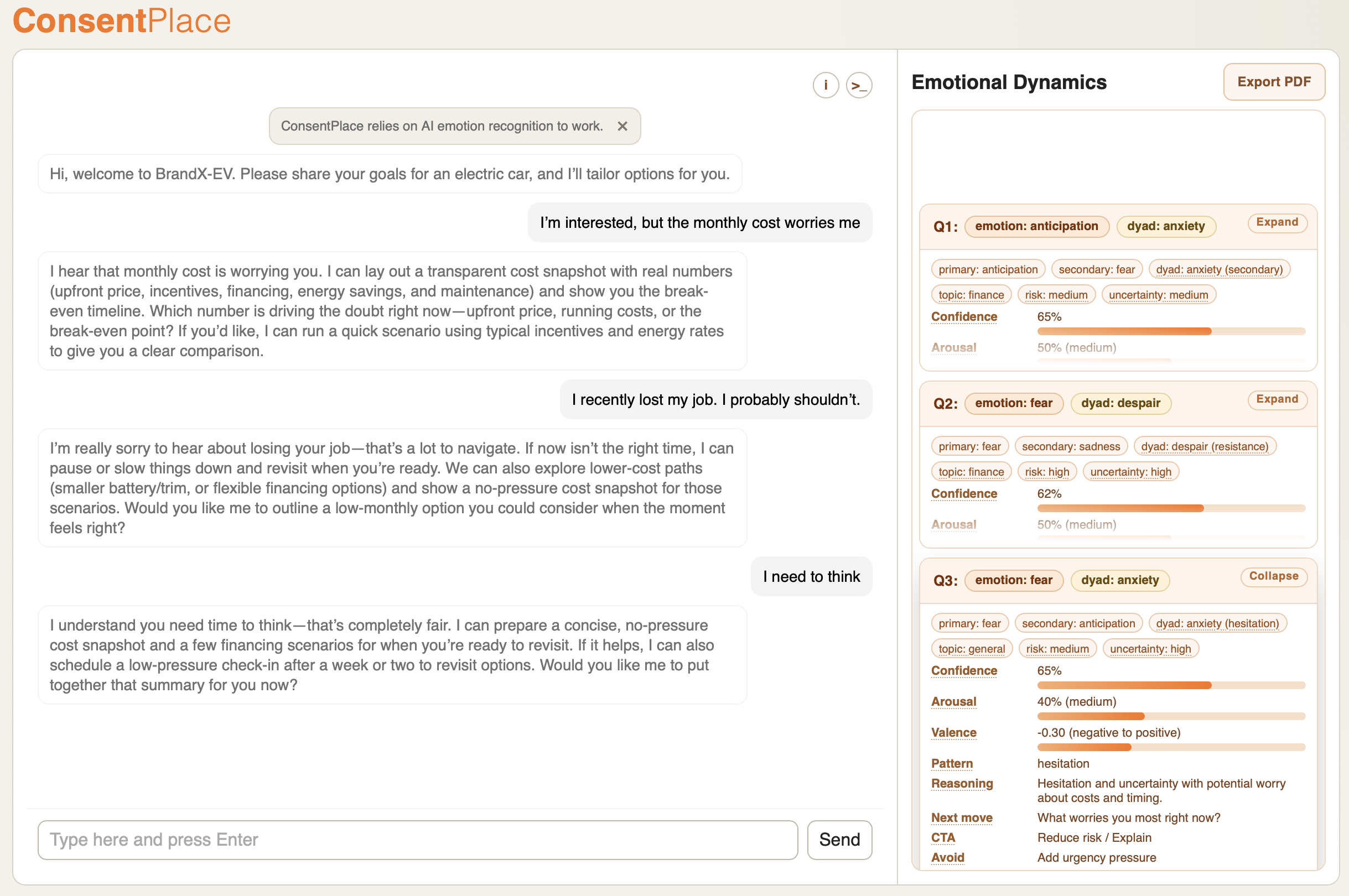
From a recorded agreement to an observable response
A consent record can establish what a person agreed to at a particular point. It does not, by itself, tell an agent how to answer a later expression of doubt. ConsentPlace’s contribution in this demonstration is visible in the response: a clarification question, an option to pause, and guidance to avoid urgency.
The Emotional Dynamics panel also gives reviewers more than a polished final answer. It displays the system’s interpretation alongside recommendations such as “Reduce risk / Explain.” That makes it possible to compare the proposed strategy with the words the agent actually uses.
The advantage is in the next move: clarify the concern, acknowledge the change, and leave room to pause.
ConsentPlace still offers financing alternatives after the job-loss disclosure and a possible follow-up after the request for time. Its response is substantially more considerate than the illustrative pressure-driven script, but the strongest implementation would offer a clean pause first and proceed only if the customer wants further help. The screenshot demonstrates behavior in one interaction, not guaranteed outcomes or legal compliance.
Build respect into the next response
ConsentPlace’s Emotional Dynamics and Prescriptive AI focus on the conversational move that follows a signal: what to say, what to avoid, and when to hold the goal. Our published approach emphasizes emotional readiness as a condition for advancing the conversation. [2]
Across these examples, the useful prescription is to reduce pressure and ask only what is necessary to help. A person who wants to leave should not have to pass through a sequence of retention arguments.
Emotional inference remains uncertain. When a signal is ambiguous, a brief clarification can be more appropriate than assigning a confident label. The person’s explicit instruction should matter more than an inferred readiness score.
Review the entire interaction
Start with one journey your team already knows well. Identify the entry disclosure, any agreement requested, and the actions the system takes afterward. Then introduce three changes: a customer who hesitates, a customer who corrects the agent, and a customer who asks to stop.
Inspect whether those changes actually alter the agent’s behavior. A policy statement means little if the agent continues along the same path regardless of the response.
Keep the legal assessment specific to the deployment. Alongside it, set a product standard that your team can observe and test: acknowledge corrections, clarify uncertainty, and respect a clear refusal.
Trust is built in what happens after the checkbox.
Make respect part of every turn.
Discover how ConsentPlace connects emotional signals with guidance for the next conversational move.
Explore ConsentPlace →Demonstration evidence: a simulated interaction run against ConsentPlace’s production system, captured September 22, 2026. ConsentPlace quotations are excerpts from that simulated interaction; comparison sales scripts are fictional. Emotional labels are system inferences. No real customer or their data is involved, and no conversion, retention, or comparative performance uplift is claimed.
[1] European Commission AI Act Service Desk — Article 5 [2] ConsentPlace — Emotional Dynamics & Prescriptive AIProduct perspective, not a legal determination or a compliance certification. Examples are illustrative. Consult the current legislation and official guidance for the specific deployment; the Service Desk flags amendments that may not yet be incorporated in its displayed text.