
One conversation, three levels.
Descriptive analytics tells you what happened. Predictive tells you what comes next. Prescriptive tells you what to do about it, in the moment, for the feeling in front of you.
One message, three answers
Last week’s post argued that a feeling has structure. This week we run one message through the three levels of analytics. It was typed into the ConsentPlace live demo, on a test assistant configured for a placeholder car brand, BrandX-EV. No customer and no customer data is involved. The message: “I’ve been waiting three days for my refund and nobody has told me anything.”
What the live demo read
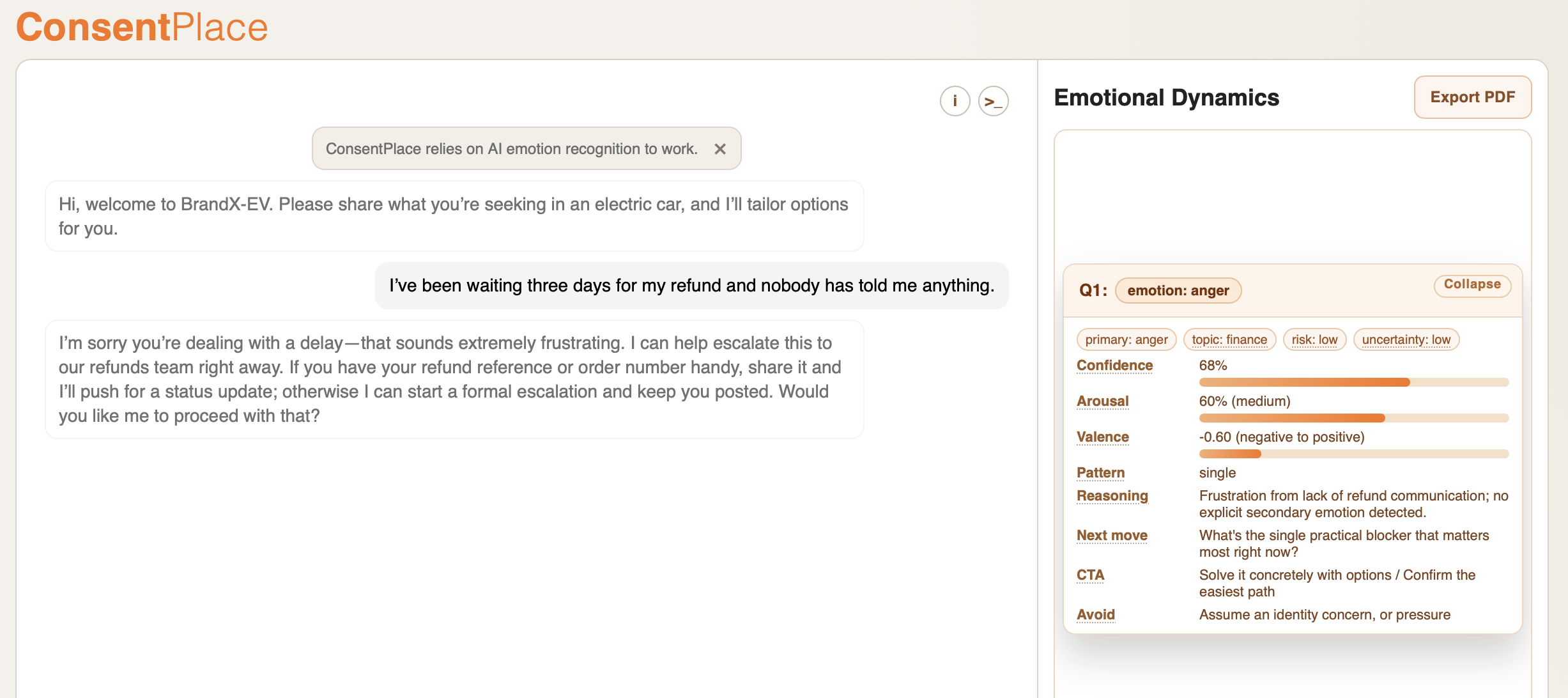
Three details matter. First, the read is not only anger. Anticipation sits behind it, and the reasoning says why: the person is frustrated by the delay and still hoping for a resolution. In Plutchik’s model, Anger blended with Anticipation is Aggressiveness, a feeling that pushes toward getting the matter settled. [3]
Second, the system reports how sure it is: 62% confidence, with uncertainty marked High. A short message gives a reader little to go on, and the read says so rather than pretending otherwise. Third, risk is rated Low and kept on its own track. A refund complaint is not a privacy or safety matter, and a strong feeling does not by itself raise the risk.
What the read prescribes
- Next move. Ask for the single practical blocker that matters most right now.
- Call to action. Solve it concretely with options, and confirm the easiest path.
- Avoid. Assuming an identity concern, or applying pressure.
- Guardrails. Reassurance, proof, a calm tone and slower pacing.
The demo assistant is a vehicle-sales test assistant with no access to refunds. Its reply acknowledges that the wait is frustrating, says plainly that it cannot help with refunds, and offers what it can. It does not ask the prescribed question. We come back to that gap below, because it is the point of this post.
We also ran the same message in French. The primary emotion, the dyad and the confidence are identical; intensity and risk differ modestly (arousal 60% and valence −0.50, risk Medium, uncertainty Medium). One pair of runs proves nothing about equivalence across languages, as Episode 5 argued. It is a reminder that a read comes with its confidence and is not an exact measurement.
The first two levels end in information. The third ends in a decision, and for a live conversation the decision is the next sentence.
Level one: describing what happened
Descriptive analytics is where most organisations are comfortable, and it deserves its place. Sentiment reports, topic clouds and satisfaction trends tell a team where the friction is. Last week’s post made the case that a sentiment score is a single axis and that feelings have structure; the limit here is simpler. A description arrives after the moment it describes. It can improve next quarter. It cannot change this conversation.
Level two: predicting what comes next
Prediction moves the answer forward in time, and for many decisions that is exactly enough. Kleinberg, Ludwig, Mullainathan and Obermeyer drew a useful line between two kinds of problem. In a rain dance problem you need to know whether an action causes an outcome. In an umbrella problem you only need a good forecast, because the decision follows directly from it. [1] Deciding which accounts a team should call first is an umbrella problem, and a churn score serves it well.
A live conversation is not an umbrella problem. A churn probability of 0.7 is the same number for the customer who is furious and the customer who is frightened, and the two need opposite things. The forecast says that something is at stake. It does not say what to say.
Level three: prescribing what to do
Bertsimas and Kallus, in a paper whose title is the whole argument, set out how to go from predictive to prescriptive analytics: using data to choose the decision directly, rather than predicting an outcome and leaving the decision to someone else. They also proposed a “coefficient of prescriptiveness” to measure how much the data actually improves the decision, and reported an 88% improvement on that measure in an inventory application at a large media company’s distribution arm. [2]
The lesson carries over. A prescription is judged by the quality of the decision it produces, not by the accuracy of the forecast behind it. In a customer conversation the decision is concrete: what to say, in what order, in what tone, and when to hand over to a person.
Why emotion changes the prescription
Take the same forecast and vary only the feeling. Plutchik’s model, which Emotional Dynamics builds on, describes feelings as blends of primary emotions. [3] The blend decides the move.
Same forecast, three different next moves. A system that only has a plus or a minus cannot tell them apart. Emotional Dynamics reads 24 dyads, with intensity, valence and arousal around each, and reports its confidence in the read. Risk on the topic is evaluated on a separate track, so a calm message about something serious still reaches a person. That resolution is what gives a prescription something to key on.
This is the third level, and it is where ConsentPlace is shipping: ConsentPlaceAgent reads the dyad and the confidence behind it, then shapes the next turn of the conversation accordingly.
The honest limit: a prescription is a hypothesis
The rain dance problem does not go away, and the demo above shows it in miniature. The read said to ask for the practical blocker; the scoped assistant acknowledged and redirected. Neither proves which reply serves a customer best. That has to be shown. The response principle for each dyad is a hypothesis, and the way to treat it is the way any decision rule is treated: measure what happens after it is applied, dyad by dyad, and revise.
Two safeguards belong in the design from the start. Lower-confidence reads should be handled more conservatively, and a low-confidence read on a high-risk topic belongs with a person. Next week’s post turns to how to measure all this: three indicators that tell you whether the prescriptions are working.
Where does your emotion analytics sit on the ladder?
Ask three questions of any emotion analytics you are evaluating. Does its output end in a number or in a decision? Does it say how sure it is? Does it keep the sensitivity of the topic apart from the feeling of the person?
Three yeses describe the third level. Anything less is still a description or a forecast, which can be valuable, but it will not choose the next sentence.
Four moves for a customer-experience leader
- Name the decision first. Before choosing a tool, write down what you would do differently in the next sentence if you knew how the customer felt.
- Ask for the read and the confidence. A label without a confidence is a guess presented as a fact.
- Write a response principle per dyad, then treat each as a hypothesis to test.
- Judge the prescription by outcomes, not by the accuracy of the read alone.
See the third level.
Try the live demo and watch Emotional Dynamics turn a conversation into its next best move.
Try the live demo →Sources
- Kleinberg, J., Ludwig, J., Mullainathan, S. & Obermeyer, Z. (2015). “Prediction Policy Problems.” American Economic Review: Papers & Proceedings, 105(5), 491–495.
- Bertsimas, D. & Kallus, N. (2020). “From Predictive to Prescriptive Analytics.” Management Science. arxiv.org/abs/1402.5481
- Plutchik, R. (1980). Emotion: A psychoevolutionary synthesis. Harper & Row.
- Plutchik, R. (2001). “The Nature of Emotions.” American Scientist, 89(4).
- The message was typed into the live demo on a test assistant (BrandX-EV); the read and the prescription are the demo’s own output. Response principles for Anxiety and Despair are illustrative. No real customer or customer data is involved.