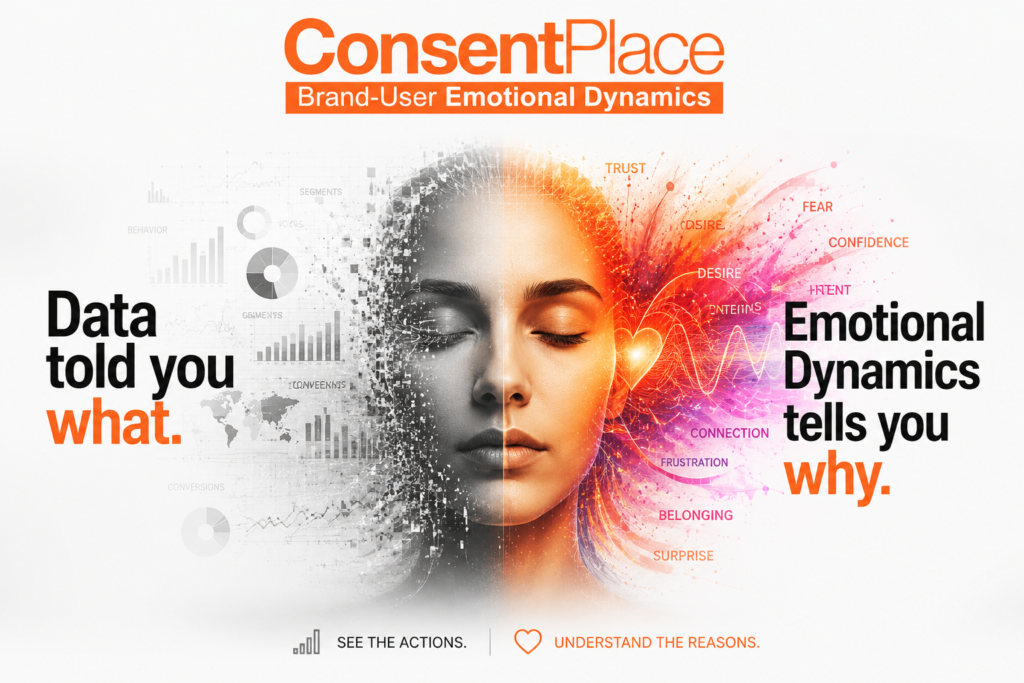
AI Enterprise · Emotional Dynamics · Product
Here are the 8 Emotional Dynamics instruments that tell you How.
Every enterprise AI stack tells you what happened. ConsentPlaceAgent tells you why — and exactly how to act on it. These are the eight capabilities that close the gap.
Executive Summary
Your data tells you a customer sent a complaint, abandoned a cart, or churned. It cannot tell you why they felt what they felt at the moment the decision was made.
ConsentPlaceAgent closes that gap with eight distinct capabilities — each one answering a Why that data alone will never reach. Built on 46 years of peer-reviewed science. Three lines of code on your existing stack.
Data · The What
Customer churned at Week 8.
Ticket resolved. CSAT: 4.3/5. Resolution rate: 92%. Everything looked fine.
Emotional Dynamics · The Why
Contempt detected at Week 1.
The decision was made 7 weeks before the ticket. The signal was there. Nobody was reading it.
This is the gap. Not a technology gap — every major platform has sophisticated AI. A science gap. Data measures events. Emotional Dynamics measures the state that produces events. One tells you what happened. The other tells you why it was always going to happen — and gives you the window to change it.
ConsentPlaceAgent closes that gap with eight capabilities, each built on Robert Plutchik’s psychoevolutionary model — the only framework for human emotion confirmed inside large language models by Anthropic’s interpretability team in April 2026. Not sentiment analysis. Not keyword scoring. 24 emotional dyads detected in real time, turn by turn, in every conversation.
Data tells you the customer left.
Emotional Dynamics tells you they had already left — weeks before the ticket arrived.
The 8 instruments — What · Why · How
What your data sees. What ConsentPlaceAgent sees — and does.
Each capability answers a Why data cannot reach — then tells your AI exactly How to act on it. Together, they form the only full-stack emotional intelligence layer available for enterprise AI — on your existing stack, in three lines of code.
Data tells you What
The customer sent a message. The AI generated a response. The response was factually correct and matched the brand tone guidelines.
Emotional Dynamics tells you Why
The customer was in Remorse — still reachable, looking for validation, not information. The correct response was emotional acknowledgment. A factually correct answer accelerated disengagement.
Calibrated Response Generation calibrates the reply to the emotional state — not the content of the message. Users feel understood. That is the difference between a conversation that builds loyalty and one that ends it.
Data tells you What
Sentiment score: negative. The customer expressed dissatisfaction. The ticket was escalated based on a negative flag. Resolution time increased.
Emotional Dynamics tells you Why
The customer was in Hope + Fear — the dyad of someone who wants to buy but is afraid of making the wrong choice. The correct response: reassurance, not escalation. The escalation made the anxiety worse.
3 sentiment scores flatten 24 distinct emotional states into a single flag. The customer in Remorse and the customer in Cynicism both score “negative” — and require opposite interventions. Only 24-dyad detection tells them apart.
Data tells you What
The customer did not complete the purchase. They spent 4 minutes on the product page, opened the cart, and left without converting. Retargeting campaign triggered.
Emotional Dynamics tells you Why
The customer was in hesitation — not resistance. Hesitation needs reassurance. Resistance needs space. The retargeting campaign pushed on a customer who needed validation, and turned hesitation into resistance.
Hesitation and resistance look identical in behavioral data. They require opposite responses. Dynamic Patterns detects which one is developing — turn by turn — before the customer makes the decision you cannot reverse.
Data tells you What
Interaction flagged as negative. The customer’s language indicated dissatisfaction. Sentiment score: –2.4. Case opened for human review.
Emotional Dynamics tells you Why
High arousal, low certainty: the customer was in anxiety, not anger. Anxiety wants resolution and confidence. Anger wants acknowledgment. Opening a human review case signaled escalation — which raised the arousal further.
Direction (positive/negative) without intensity is half the signal. Appraisal Signals measure valence, arousal, and certainty simultaneously — because the same emotion at low and high intensity requires entirely different responses.
Data tells you What
The customer mentioned pricing. Standard pricing objection response triggered. Discount offer generated automatically per playbook rule.
Emotional Dynamics tells you Why
The pricing mention carried high emotional charge — the customer was not negotiating, they were expressing a trust concern. A discount offer at that emotional moment signaled desperation, not value. It confirmed their doubt.
Sensitive topics — finance, privacy, safety — trigger different emotional responses depending on the emotional state they land in. Topic Risk detects the combination and adjusts the register before the damage is done.
Data tells you What
GDPR compliance rule applied. Disclosure triggered at 5-minute mark per configuration. Privacy notice delivered. Session logged as compliant.
Emotional Dynamics tells you Why
The customer was in Cynicism when the disclosure fired — the worst possible emotional state to receive a legal notice. It confirmed their suspicion that the brand was hiding something. Delivered in a Trust state, the same notice builds credibility.
Compliance at the wrong emotional moment is compliance theater. Guardrails fire at the emotionally right moment — not on a timer, not at a fixed interval, but when the conversation state makes them land as care rather than obligation.
Data tells you What
Next best action: offer a 10% discount. Customer profile: high-value, lapsed buyer. Standard win-back campaign triggered. Conversion rate: 8%.
Emotional Dynamics tells you Why
The customer was in Remorse — they missed the brand, not the price. The right question: “What did you love most about your last order?” Two CTAs: reorder it, or discover what’s new. Conversion rate with emotional routing: 31%.
A generic next-best-action ignores the emotional context that determines whether any action works. Playbook Routing surfaces the optimal question and two emotionally matched CTAs per detected state — not per behavioral segment.
Data tells you What
Consent request delivered at session start per standard flow. Consent rate: 34%. 66% dismissed without reading. Compliant. Suboptimal.
Emotional Dynamics tells you Why
Session start is the worst emotional moment to ask for consent — the customer has no evidence yet that sharing is worth it. Delivered after a Trust dyad is detected, the same request feels like an invitation. Consent rate: 67%.
Consent at the wrong moment feels intrusive. At the right moment, it feels like care. Consent Timing detects the emotional window — the moment the customer is most likely to say yes, and most likely to mean it.
Eight instruments. One architecture. What, Why — and How.
Each capability answers a Why data alone will never reach — then tells your AI exactly How to act on it. But their real power is cumulative. A conversation running all eight simultaneously does not just detect emotional states — it understands why the customer feels what they feel, how intensely, and precisely what to do about it, at every turn, before the decision you cannot reverse.
That is the difference between a thermometer and a navigation system. Data gives you the temperature. Emotional Dynamics gives you the direction, the speed, and the road ahead.
24
emotional dyads detected — not 3 sentiment scores
8
distinct capabilities, each answering a Why data cannot
3
lines of code on your existing stack
Data tells you the customer left.
Emotional Dynamics tells you which of 24 states they were in when they decided to.
The 8 instruments — What · Why · How tell you exactly what to do — before they do.
ConsentPlaceAgent is live. Built on Plutchik’s psychoevolutionary model — the only emotional framework confirmed inside large language models. GDPR-native by design. On your existing stack in three lines of code.
What. Why. How. All three. In every conversation.
ConsentPlaceAgent is live. Three lines of code. No rip-and-replace.
Contact Us →
References & Sources
- Anthropic Interpretability Team (April 2, 2026). Emotion concepts and their function in a large language model. Functional emotional representations confirmed inside LLMs, organized in a structure that echoes Plutchik’s psychoevolutionary model.
- Plutchik, R. (1980). “A general psychoevolutionary theory of emotion.” — (2001). “The Nature of Emotions.” American Scientist, 89(4), 344–350.
- Zendesk CX Trends Report (2026). 72% of CX leaders believe AI agents should reflect the brand’s identity and values — while most current systems still operate on keyword logic.
- CX Today (March 2026). Why Emotion Intelligence Is the Missing Layer in AI-Powered CX. Most enterprise AI systems operate on keyword pattern-matching rather than genuine emotional understanding.
- Adobe 2026 AI & Digital Trends Report. 39% of customers would not object to brands using AI to predict their emotional state, provided the interaction delivers genuine value.
- The customer didn’t complain. Didn’t escalate. Just quietly decided to leave. — ConsentPlace Blog, May 2026.
- Data told you What. Emotional Dynamics tells you Why. — ConsentPlace Blog, May 2026.
- Past. Present. Plug in. — ConsentPlace Blog, May 2026.
- Anthropic Just Proved Why ConsentPlace’s Emotional Dynamics Is Not Optional — ConsentPlace Blog, April 2026.