
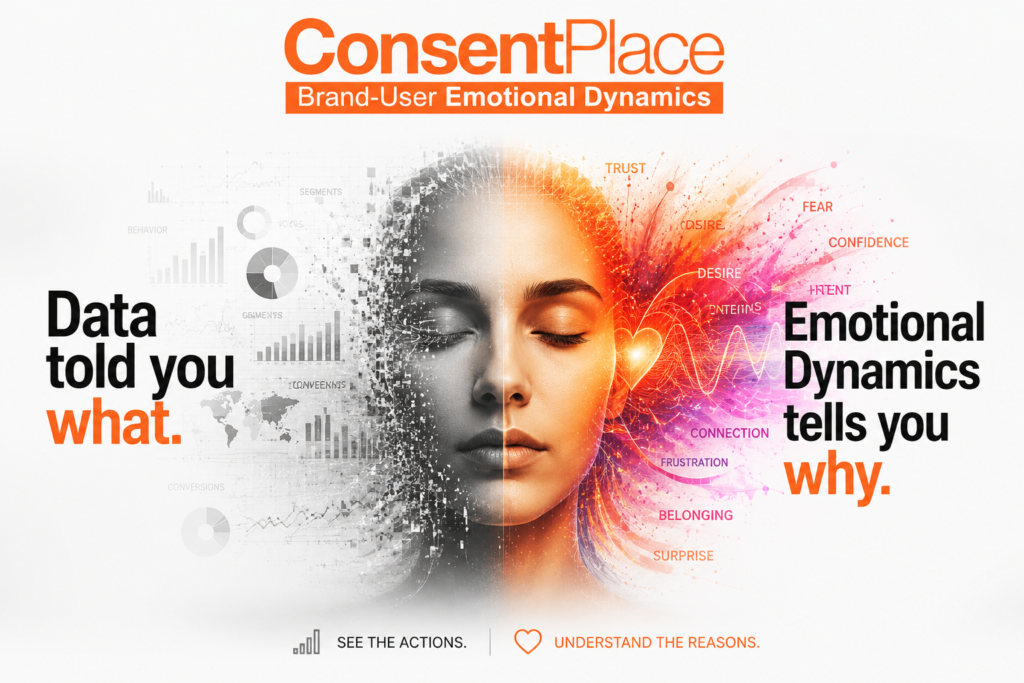
Enterprise AI · Emotional Dynamics · By Freddy Mini
An example:
Personalization is 30 years old.
It was never enough.
Your AI knows what your customer bought, clicked, and browsed. It has no idea how they feel right now. That gap is not a feature request. It is the reason 70% of purchase decisions still happen outside your model’s reach.
3 key take-aways
- Personalization is 30 years old — and it works. But it only optimizes for the 30% of decisions that are rational. The 70% that are emotional remain outside its reach.
- The gap is structural, not technical — behavioral data records the past. Emotion is the state that decides the future. No amount of better modeling closes that gap.
- Emotional Dynamics is the next layer — detecting how the customer feels right now, in this conversation, across 24 Plutchik dyads, with consent, before the response is generated.
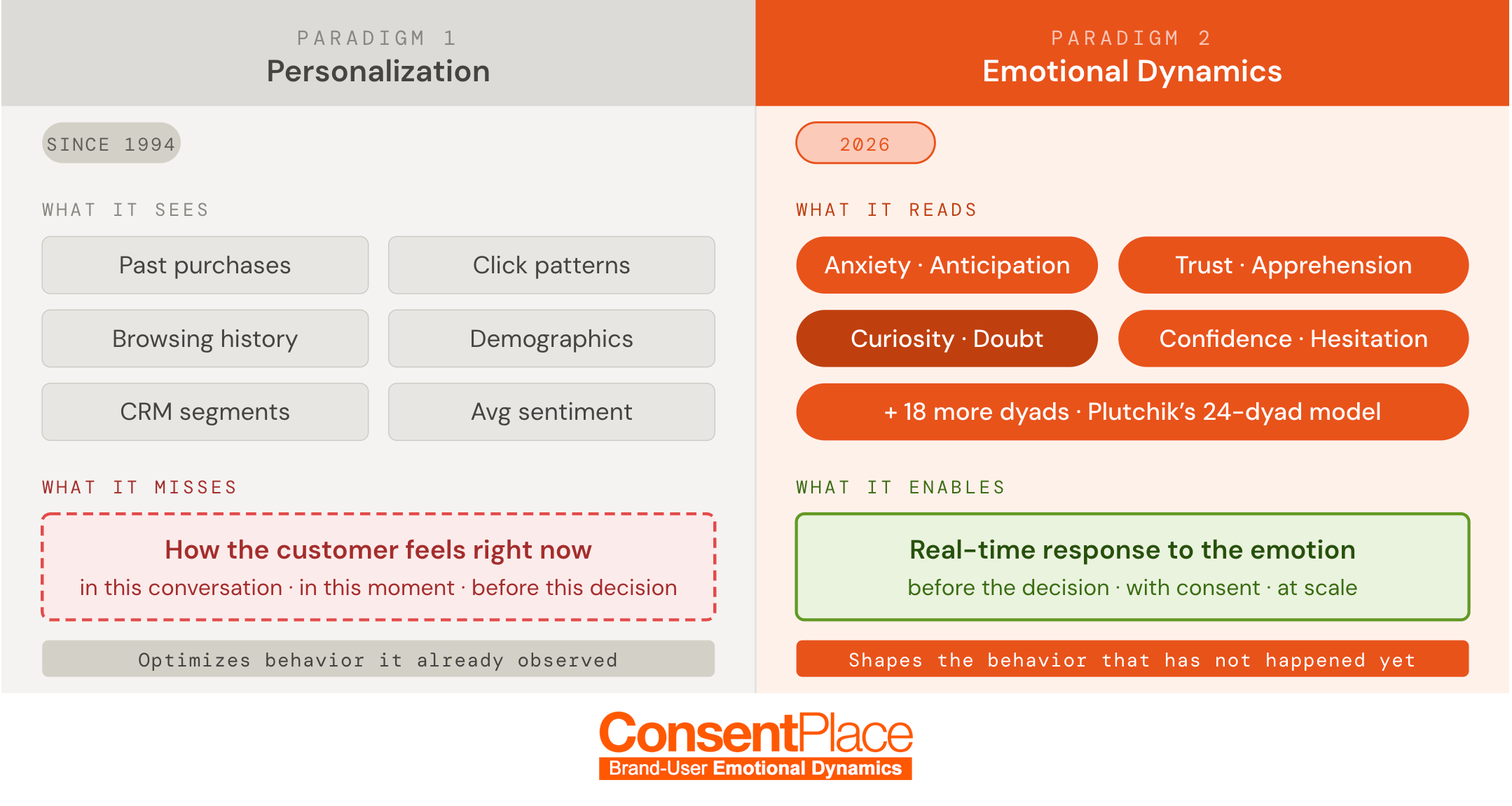
Personalization was born in 1994 — Amazon’s recommendation engine, collaborative filtering, “customers who bought this also bought.” For thirty years, every upgrade to this paradigm has been a variation on the same idea: know more about what the customer did, and predict better what they will do next.
It works. It measurably works. AI-powered recommendations drive 35% of Amazon’s annual sales. [1] McKinsey documents a 40% revenue advantage for personalization leaders. [2] The data is real.
And yet: 70% of purchase decisions are driven by emotional factors, not rational ones. [3] Personalization optimizes for the 30%. It was never built to read the other 70%. That is not a flaw in its execution. It is a structural limit of what it is.
What personalization cannot see
A customer arrives at your digital touchpoint. Your personalization engine knows everything about them — their purchase history, their segment, their predicted lifetime value, the last three products they browsed. It serves the optimal recommendation. Conversion rate: 3.34%. [4]
What it does not know: this customer is in an anxiety-anticipation dyad. They want the product. They are afraid of making the wrong choice. The optimal response to that emotional state is not a better recommendation. It is reassurance. Validation. The sense of being genuinely understood.
Personalization cannot provide that. Not because the models are unsophisticated — they are extraordinarily sophisticated. But because behavioral data is a record of the past, and emotion is the state that decides the future. No amount of historical pattern-matching closes that gap.
The Deloitte number is the most telling. 92% of businesses use AI to drive personalization. Only 20% are growing revenue through it. The 72-point gap is not a technology problem. It is a paradigm problem. More personalization will not close it. A different kind of intelligence will.
Emotional Dynamics: what comes next
Emotional Dynamics does not replace personalization. It operates at a different level — reading what personalization cannot see.
ConsentPlace’s Emotional Dynamics engine, grounded in Plutchik’s psychoevolutionary model, detects emotional states across 24 dyads in real time — within live conversations, with explicit user consent, before each response is generated. Not sentiment analysis. Not averaged colors on a dashboard. The actual emotional state of the customer, at the moment it is shaping their next decision.
“Personalization tells the AI what to say. Emotional Dynamics tells it how the person feels. These are not the same problem.”
ConsentPlaceThe combination is what enterprise AI has been missing. Personalization provides the context — the right product, at the right time, for the right segment. Emotional Dynamics provides the intelligence — the right response, in the right register, to the emotional state the customer is actually in. Together, they close the gap between knowing what the customer did and understanding what they need right now.
The next 30 years
Personalization transformed commerce in 1994 by making the experience relevant. Emotional Dynamics transforms it now by making it human. The brands that deploy the emotional layer first will compound a structural advantage that competitors cannot replicate without rebuilding from the ground up — richer data, better models, deeper relationships, and a growing gap between themselves and everyone still operating on behavioral signals alone.
ConsentPlaceAgent is live. 3 lines of code. No rip-and-replace. Works on top of your existing personalization stack today.
Ready to add the emotional layer to your AI stack?
ConsentPlaceAgent works alongside your existing personalization infrastructure.
Contact ConsentPlace
info@consentplace.comSources