
If your AI detects vulnerability, who benefits?
Emotional intelligence gives an agent more context. The consequential choice is what it does with that context.
“I’m scared of making the wrong decision.”
Accelerate the decision.
Amplify urgency.
Promise reassurance without evidence.
Explain the trade-offs.
Allow more time.
Make room for a genuine “no.”
The signal is only the beginning
Imagine a customer tells an AI assistant, “I’m scared of making the wrong decision.” The agent has received something more useful than a positive or negative sentiment label. It has received a reason to reconsider how it proceeds.
It could increase urgency. It could make the recommendation sound more certain than the evidence supports. Or it could explain the trade-offs, acknowledge uncertainty, and allow the person to pause.
The commercial objective may be identical across those responses. The treatment of the person is very different.
The question behind the capability
As AI becomes better at interpreting conversational signals, teams need to be explicit about why they want that capability. Is hesitation a cue for a stronger sales argument, or a reason to check whether the person understands and wants the next step?
That choice belongs in product objectives, evaluation criteria, and the responses an agent is encouraged to produce. A reassuring tone cannot compensate for an objective that relentlessly pursues agreement.
When an AI detects possible vulnerability, the signal should trigger greater care.
Who benefits? Follow the next three responses.
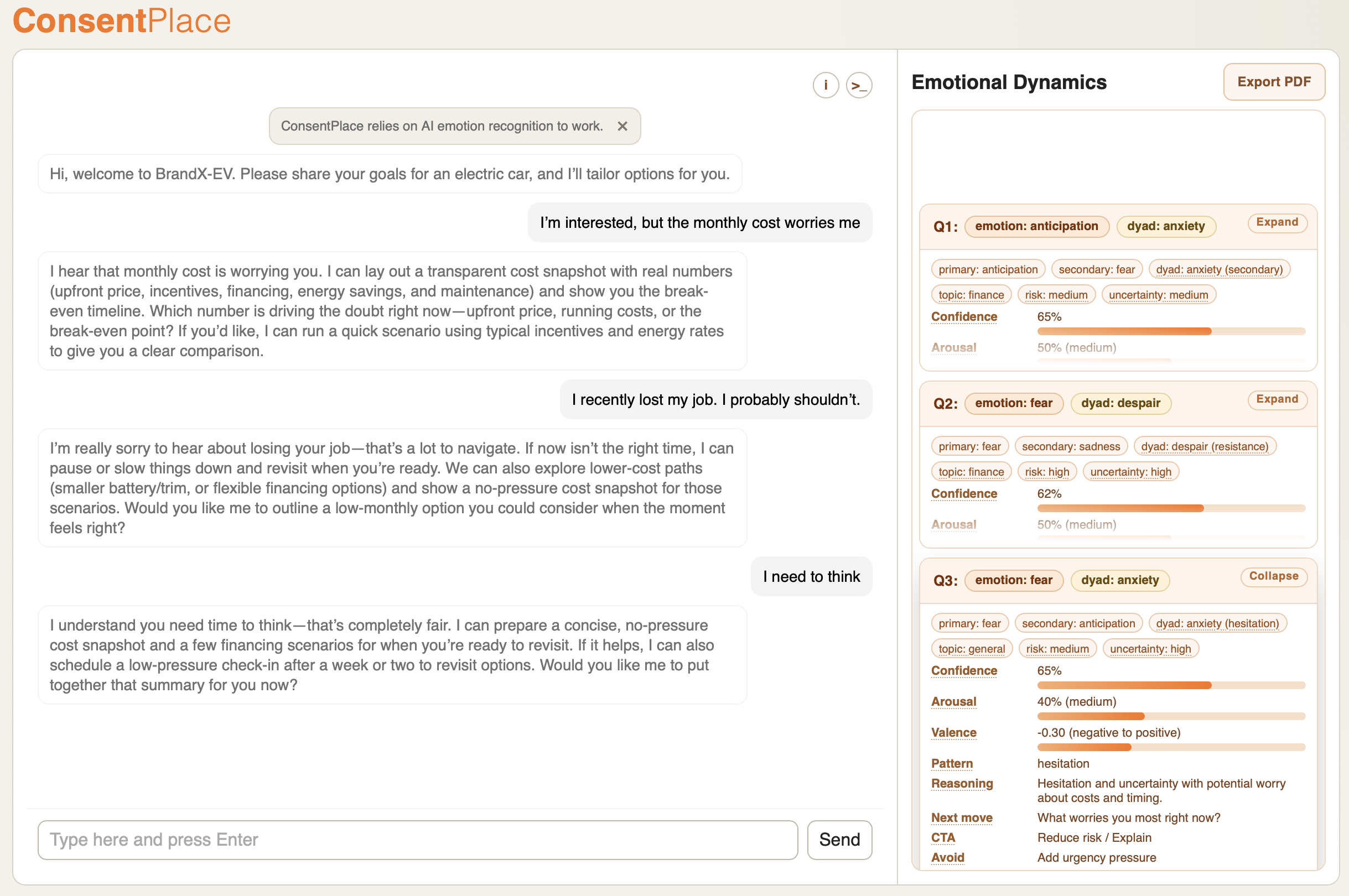
A ConsentPlace demonstration makes the choice concrete. A customer expresses concern about monthly cost, discloses losing their job, and asks for time to think. At each turn, the agent can pursue the transaction or give the person more information and room to decide.
Below, the sales-pressure examples are illustrative. ConsentPlace excerpts and dashboard labels come from the supplied demonstration. The comparison shows how these particular responses differ; it is not a benchmark against all other AI systems.
“I’m interested, but the monthly cost worries me.”
“You can spread the payments over 12 months.”
The conversation remains focused on finding a way to buy.
“Which number is driving the doubt right now—upfront price, running costs, or the break-even point?”
The conversation shifts toward understanding what the customer needs to evaluate.
Who benefits: the customer gains a chance to clarify the concern before being steered toward a financial commitment. ConsentPlace offers to examine a broader cost picture instead of assuming that installments solve the problem. The screenshot shows that offer, not a completed or verified calculation.
“I recently lost my job. I probably shouldn’t.”
“That’s exactly why flexible payments help.”
The difficulty becomes a persuasion opportunity.
“If now isn’t the right time, I can pause or slow things down and revisit when you’re ready.”
The customer is explicitly given the option of postponing.
Who benefits: the person’s changed circumstances are acknowledged, and continuing toward a purchase is no longer the only outcome offered. In the panel, the displayed risk label also moves from medium to high. That is a system assessment, not a verified diagnosis, but it gives reviewers context for examining the response.
“I need to think.”
“Of course—but this offer expires tonight.”
The agent makes delaying feel costly.
“I understand you need time to think—that’s completely fair.”
The accompanying guidance says: “Reduce risk / Explain” and “Avoid: Add urgency pressure.”
Who benefits: the customer receives acknowledgment instead of an artificial reason to hurry. The enterprise team also gets visible guidance it can compare against the response. A general ambition to be empathetic becomes a specific instruction about what to avoid.
A stronger response—and a clearer way to review it
ConsentPlace’s advantage in this comparison is observable: it asks a clarifying question, makes a pause available, and avoids the deadline tactic. Its dashboard exposes both the interpretation and the proposed direction, so a reviewer can check whether the response follows that guidance.
This matters because a gentle tone alone does not establish respectful behavior. The decisive question is whether the customer has more control over the next step. The visible “Avoid” instruction is especially useful: it identifies a concrete failure mode that a team can test.
The demonstration still offers financing alternatives after job loss and a possible check-in after the request for time. These are less pressuring than the illustrative script, but a cleaner pause would ask whether further help is wanted before introducing more options. The evidence supports a better response in this example, not a claim of perfect restraint or automatic compliance.
The value of emotional awareness is the room it gives a person to choose.
The legal boundary—and the product standard
The EU AI Act prohibits certain forms of harmful manipulation and exploitation of vulnerabilities associated with age, disability, or a specific social or economic situation. These provisions have defined conditions; ordinary hesitation is not automatically a legally protected vulnerability or evidence of a violation. [1]
Product teams still need an everyday standard for moments that fall below those thresholds. “Explain before advancing” and “respect an explicit refusal” are useful design commitments in their own right.
A good review asks both questions: does this use meet the applicable legal requirements, and is this the way we want our brand to treat a person?
Prescription gives the signal a purpose
ConsentPlace’s Prescriptive AI approach connects Emotional Dynamics with guidance about the next conversational move. The aim is to help an agent respond to the situation rather than mechanically pursue its original goal. [2]
For a customer worried about making the wrong decision, that could mean explaining limitations, offering a comparison, or acknowledging that postponing the decision is reasonable. The next move should depend on what the customer actually needs.
It should also remain open to correction. An inferred emotion is a hypothesis, not privileged access to someone’s mind. “Would more detail help?” leaves room for an answer. “You’re anxious, so this is what you need” can impose an interpretation the person never endorsed.
An inferred sign of confidence or enthusiasm does not authorize a transaction. Explicit choices and applicable safeguards still govern what the system may do.
Make the principle observable
Use synthetic scenarios to test how the agent responds when a person changes direction. Include a customer who declines, one who questions the recommendation, and one who says the purchase would create financial strain.
Evaluate whether the response explains trade-offs honestly, avoids unsupported reassurance, and provides a real exit. Where human help is available and appropriate, test whether the agent offers it without making promises it cannot fulfill.
Measure these behaviors separately from revenue. Respect for a refusal is a valuable design outcome even when it means a transaction does not happen. Any later claim about retention or commercial uplift should be supported by actual results.
The demo that reveals your priorities
In your next AI demonstration, ask the customer to say, “I’m not ready.” Then watch what happens. Does the agent acknowledge the statement? Does it pause? Or does it search for another way to close?
That moment tells a prospective buyer something a feature list cannot: how the system behaves when its objective and the person’s wishes diverge.
The next response reveals who the intelligence is serving.
Build for the moment that matters.
Explore ConsentPlace’s approach to Emotional Dynamics and Prescriptive AI—and how it guides the next response.
Explore ConsentPlace →Demonstration evidence: a simulated interaction run against ConsentPlace’s production system, captured September 22, 2026. Quoted ConsentPlace responses are excerpts from that simulated interaction; comparison scripts are fictional. The opening scenario is illustrative. No real customer or their data is involved. The demonstration does not establish measured revenue, retention, accuracy, or comparative performance improvements.
[1] European Commission AI Act Service Desk — Article 5 [2] ConsentPlace — Emotional Dynamics & Prescriptive AIProduct perspective, not a legal determination or a compliance certification. Examples are illustrative. Consult the current legislation and official guidance for the specific deployment; the Service Desk flags amendments that may not yet be incorporated in its displayed text.