
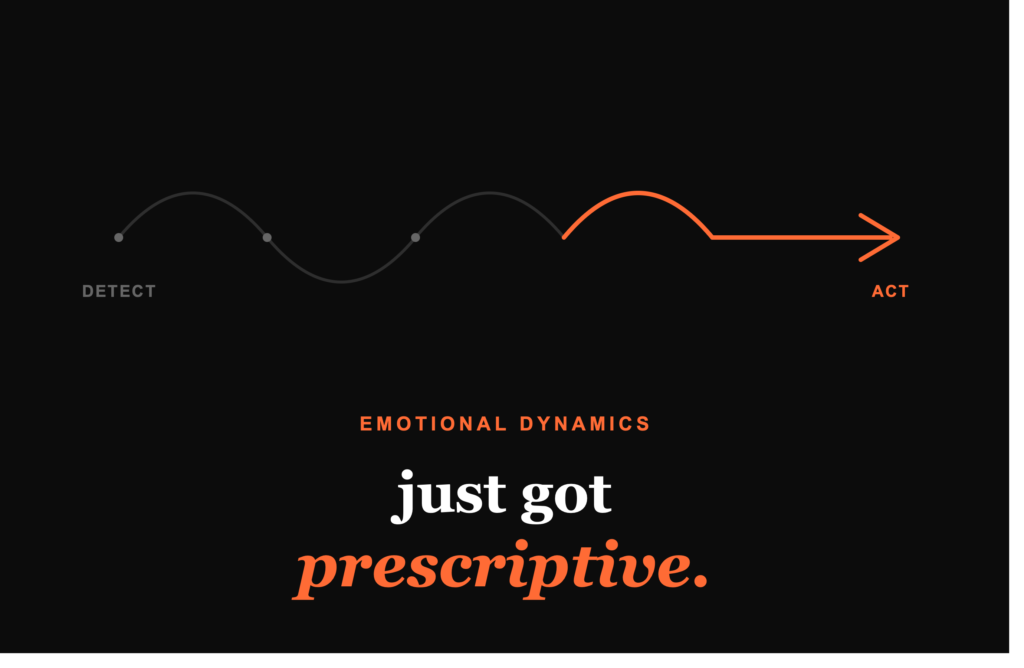
Emotional Dynamics
just got prescriptive.
ConsentPlace is Emotional Dynamics. v3 is what happens when Emotional Dynamics learns to act — not just detect. Early results are promising.
ConsentPlace is Emotional Dynamics. It always has been, and that does not change today. What changes is what Emotional Dynamics can now do with what it detects.
v3 introduces Prescriptive AI — the layer that turns a correctly detected emotional state into the right next action, at the right moment, instead of a generic next step on a fixed schedule. Internal testing on real conversation scenarios is underway, and the early results are promising.
Three generations of enterprise AI. We just claimed the third.
Enterprise AI has evolved in three distinct stages. The first two are mature, crowded, and offer diminishing differentiation. The third has been open — until now.
| Generation | The Question It Answers | Status |
|---|---|---|
| Descriptive AI | What happened? | Saturated. |
| Predictive AI | What will happen? | Crowded. |
| Prescriptive AI | What to do. Right now. For this person. | ConsentPlace. Claimed. |
Descriptive AI logs the departure. Predictive AI estimates the probability. Prescriptive AI — powered by Emotional Dynamics — tells your AI what to say at the turn that actually matters, before the customer has already decided to leave.
Emotional Dynamics detects the Why.
Prescriptive AI acts on it.
What v3 actually changes.
The insight that drove v3 came from a specific, testable observation: across independent evaluations of real conversation scenarios, emotional detection was consistently strong — but no enterprise AI architecture had solved what comes after detection. The signal was there. The prescription wasn’t. Not in any stack on the market.
The defining moment: a conversation reaches the point where a customer shares something genuinely vulnerable — not a product objection, but a hesitation about identity, trust, or readiness. This is the highest-value moment in any sales or support conversation. It is also the moment most AI systems handle worst, because they are optimized for schedules and scripts, not for what the customer actually needs to hear next.
That single architectural change — readiness gating the goal, instead of the goal overriding readiness — is the core of what “prescriptive” means in practice. Not a smarter chatbot. A system that knows when to act and when to wait, based on what the conversation is actually saying.
First results: the prescription works.
These are early internal results from active pre-production testing. A full independent benchmark is in progress — we’ll publish it as soon as it’s complete.
Why this is a category moment, not a feature release.
Most AI capability announcements describe something new the system can do. This one introduces something no enterprise AI stack currently offers: a system that reads the emotional moment precisely enough to know when acting is right — and prescribes the exact next action accordingly. Not a recommendation. Not a script. A prescription — calibrated to what this person feels, right now, in this conversation.
ConsentPlaceAgent remains exactly what it has always been: three lines of code, GDPR-native, built on Plutchik’s 50-year emotional model. Prescriptive AI is not a replacement. It is what Emotional Dynamics becomes when detection is finally allowed to do what it was always designed to do — drive the response, not just inform it.
ConsentPlace v3 is the first Prescriptive AI layer for enterprise conversations. Emotional Dynamics detects the Why. Prescriptive AI acts on it. And the early results confirm what we always knew was possible: when detection and prescription work together, the conversation doesn’t just get better. It becomes something no other stack can replicate.
Emotional Dynamics just got prescriptive.
ConsentPlaceAgent v3 is in active testing. GDPR-native. Built on Plutchik. Three lines of code.
Contact Us →References & Sources
- Past. Present. Plug in. — ConsentPlace Blog, June 2026.
- Claude, ChatGPT, Gemini: Is ConsentPlace’s Emotional Dynamics a good idea? — ConsentPlace Blog, June 2026.
- A/ proved engagement is possible. B/ proved loyalty is buildable. — ConsentPlace Blog, June 2026.
- Plutchik, R. (1980). “A general psychoevolutionary theory of emotion.” — (2001). “The Nature of Emotions.” American Scientist, 89(4), 344–350.
- Anthropic Interpretability Team (April 2, 2026). Emotion concepts and their function in a large language model.
Got Questions?