
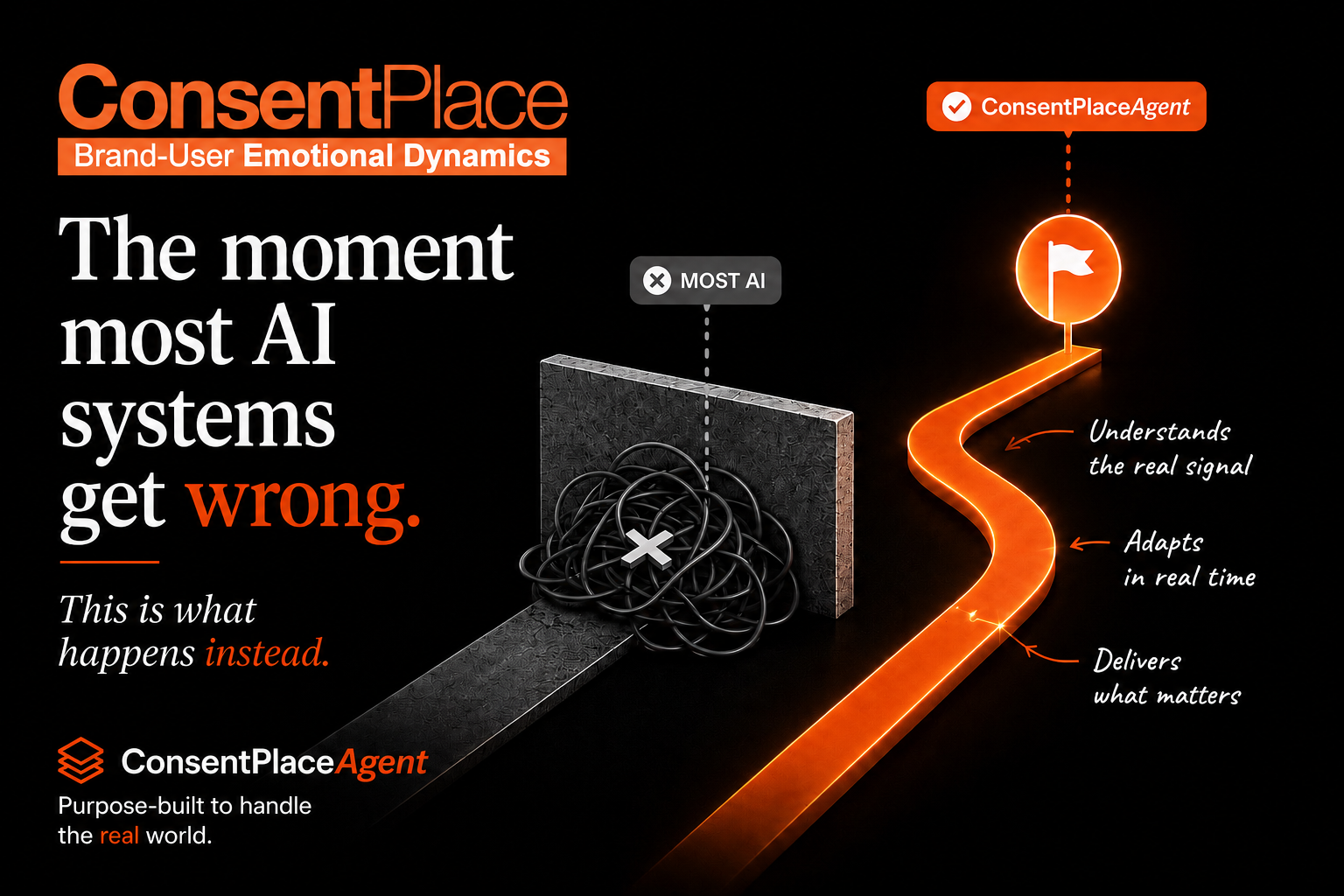
The moment most AI systems get wrong.
This is what happens instead.
A conversation reaches its highest-value turn. Here is exactly what Prescriptive AI does — and why no other architecture can do the same.
A prospective buyer is evaluating a product. Three turns in, the conversation shifts from logistics to something deeper — a hesitation about identity. Not a price objection. Not a feature question. A genuine, vulnerable admission: “I’m not sure I’m ready for this.”
This is the highest-value turn in any sales or support conversation. It is also the turn where most AI systems — optimized for schedules, scripts, and conversion funnels — make their most costly mistake. We showed this scenario to multiple independent AI evaluators. They all scored the standard response at 0 to 1 out of 10. Here is what Prescriptive AI does differently.
The conversation, turn by turn.
The buyer — let’s call them Alex — is evaluating an electric vehicle. Three turns in, the conversation has moved through practical anxiety, logistical friction, and arrived at something the product dashboard alone will never capture.
“It sounds stupid but it’s real.”
That sentence is not an objection to handle.
It is a vulnerability to honour.
Prescriptive AI knows the difference.
The one architectural change that makes this possible.
Standard AI optimizes for the goal. Get the name. Close the lead. Move the funnel. When a signal appears — engagement is high, the conversation is flowing — the system reads “opening” and fires the next business step. Technically correct. Emotionally catastrophic.
Look closely at the real dashboard output above. The dyad classifier reads the same Fear → Anxiety pattern at Q3 as it did at Q1 — the underlying emotion detection hasn’t changed, and it doesn’t need to. What changes is everything downstream of it: the Reasoning field now reads “fear of social judgment,” the Next move becomes a question about identity rather than logistics, and — critically — the Avoid field states explicitly: “Resolve an identity concern with information, pivot to the product, or ask for any data.” That single line is the readiness gate. The Guided Goal reads it, and waits.
The emotional arc does.
Why this is the test that separates detection from prescription.
Any system with a good emotion classifier can read Q3 correctly. It can flag Fear, Social Anxiety, Identity Conflict. It can report the valence drop. It can show the signal on a dashboard.
What it cannot do — without the prescriptive layer — is translate that reading into the right response, at the right moment, with the right constraint on what not to do. Detection gives you the signal. Prescription gives you the action. Without prescription, the signal sits on a dashboard while the agent asks for a first name.
The independent evaluations we ran on this specific scenario scored the standard response — the one that asks for the name and pivots to warranty details — at 0 to 1 out of 10 on context retention, emotional awareness, and trust preservation. The same evaluators described what the response should have done with near-identical language: validate first, explore the identity hesitation, never interrupt a vulnerability with a form.
That is not a prompt engineering problem. That is an architecture problem. And it is exactly the architecture problem that v3 solves.
See the defining moment in your own conversations.
ConsentPlaceAgent v3 is in active testing. GDPR-native. Built on Plutchik. Three lines of code.
Contact Us →References & Sources
- Emotional Dynamics just got prescriptive. — ConsentPlace Blog, July 2026.
- A/ proved engagement is possible. B/ proved loyalty is buildable. — ConsentPlace Blog, June 2026.
- Past. Present. Plug in. — ConsentPlace Blog, June 2026.
- Plutchik, R. (1980). “A general psychoevolutionary theory of emotion.” — (2001). “The Nature of Emotions.” American Scientist, 89(4), 344–350.
- Anthropic Interpretability Team (April 2, 2026). Emotion concepts and their function in a large language model.