
Agentic QA:
AI that grades AI.
Quality assurance for emotional AI cannot be done by humans at scale, or by unit tests. Here is what comes next — and why it changes everything about how AI gets shipped.
The AI industry has a quality problem it hasn’t named yet. Unit tests prove code runs. They cannot prove an AI behaves well. As AI systems become more emotional, more contextual, and more autonomous, the gap between “it passed the tests” and “it responds well to humans” becomes the most dangerous gap in software.
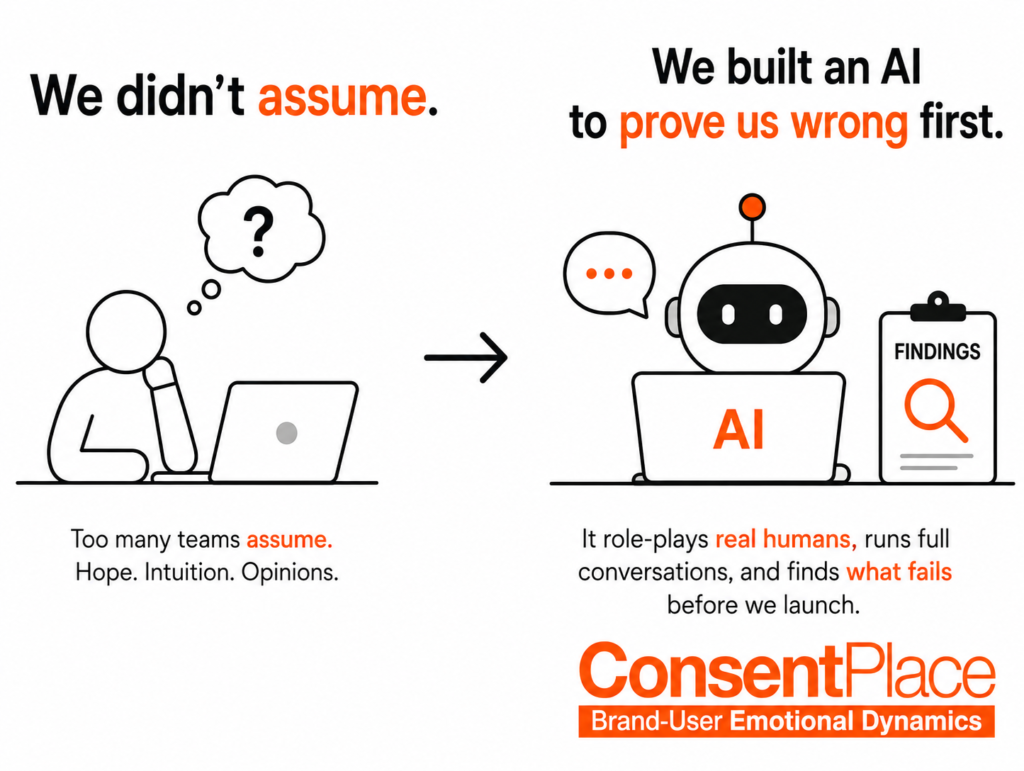
Agentic QA is our answer: an AI system that role-plays real humans, conducts full conversations with the agent under test, and scores every exchange independently — the same way a senior quality engineer would, but at a scale no human team could sustain. We built it because we had to. We’re sharing it because every serious AI team will need it.
The quality gap that conventional testing cannot close.
Standard software testing was built for deterministic systems. Input X produces output Y. If Y matches the expected value, the test passes. That model works perfectly for code that computes. It breaks entirely for code that converses.
An emotional AI agent can detect the right emotion, route to the right prescription, and still generate words that ignore everything the system just understood. Detection right. Routing right. Response wrong. That is not a bug — it is a gap between understanding and expression. And it is completely invisible to a unit test.
The only way to catch it is to put the agent in front of a human who reacts authentically — who discloses fear, hesitates, changes their mind, refuses, warms up. But humans cannot do this at the scale, consistency, or speed that iterative AI development requires. Agentic QA replaces the human evaluator with an AI that simulates one — and the human judge with an AI that scores independently.
“Did the code run?” says nothing about
whether it responded well.
We needed a different kind of proof.
Why the answer had to be agentic.
We didn’t need more tests. We needed a different kind of test — and four things forced it.
Emotional quality only lives in the arc, not in the single turn. Whether a reply lands depends on what came before — the fear a customer disclosed two turns ago, the hesitation the agent is supposed to remember. You can’t judge that from an isolated input/output fixture. Every test has to be a real, multi-turn conversation.
The moment you script the customer, you only test the paths you already imagined. A fixed script decides the conversation in advance. An AI that reacts to what the agent actually says goes down the paths you didn’t foresee — it warms up, cools off, gets reluctant, changes its mind mid-conversation. That is exactly where the failures hide.
You can’t be vulnerable to a fixture. Testing empathy needs something to be empathetic to. Only a role-played human can disclose an identity fear, hesitate, or refuse — which is the only way to check the one thing that matters most: does the agent push when it shouldn’t?
Neither the coverage nor the judgment scales by hand. A standard sweep runs at least three full conversations across each of Plutchik’s 24 emotional dyads — 72 in all — and we can dial that far higher whenever a version needs deeper scrutiny. No team hand-writes or hand-grades that volume of nuance. So the humans are simulated — persona × locale × dyad × trajectory — to make the coverage real, and the grader is an independent LLM-as-a-judge: a separate model from the one under test, scoring each transcript so we are never grading our own homework.
That is why it isn’t just a bigger test suite. It is an AI built to behave like the customers the agent serves — because that is the only environment where emotional intelligence can actually be observed.
The agentic testing chain — five layers.
The architecture has five layers — each one solving a specific failure mode of conventional testing. Together they form a closed loop: the agent is tested by an AI that behaves like a human, judged by an AI that never grades its own homework, and audited in a record that can replay any conversation from any version.
What it changes about how AI gets built.
Agentic QA does something conventional testing never could: it makes intuition falsifiable. Every hypothesis about what the agent should do — steer toward conversion here, validate identity there, stay silent when the user is vulnerable — becomes a measurable prediction. The chain confirms or rejects it before the code ships.
In our own development, the chain caught two ideas that seemed correct and measured as wrong: minimizing reasoning across the board (faster, but killed conversion entirely) and caching emotion detection on stable turns (logical, but missed most emotional shifts in practice). Both ideas were rejected with data — not with debate. That is the point. Agentic QA converts taste into evidence.
The deeper shift is cultural. A team with Agentic QA stops asking “does this feel right?” and starts asking “what does the data say?” The agent’s behavior becomes auditable, reproducible, and comparable across versions. And because every conversation is logged verbatim — including the ones that fail — the system builds institutional memory. You can replay the conversation that broke in version 2 and confirm it no longer breaks in version 4.
Every hypothesis about what the agent should do
becomes a measurable prediction.
The chain confirms or rejects it
before a single user sees it.
Why Agentic QA is the next frontier.
Every serious AI team is about to face the same problem we faced: their agent works in demos, passes unit tests, and fails in production in ways nobody anticipated. The failures aren’t bugs — they are emergent behaviors of a system that interacts with human beings across infinite contexts. No static test suite covers that. No human team grades it consistently at scale.
Agentic QA is the answer. Not because it is clever engineering — but because it is the only way to close the gap between what an AI understands and what it actually says to a human being in a vulnerable moment. The gap is real. The tooling to close it now exists.
We built it for ConsentPlaceAgent because Prescriptive AI without proof is just a claim. But the principle generalizes: any AI system that serves humans in emotionally complex contexts — sales, support, health, education, financial guidance — needs a version of this chain. The age of shipping AI on intuition is ending. The age of shipping AI on evidence is beginning.
Every version — and every rejection —
was decided by data from this chain.
We didn’t guess. We proved it, or we didn’t ship it.
Emotional AI without this kind of validation is a demo. It might work in the cases you’ve seen. It will fail in the cases you haven’t imagined yet. The agentic testing chain is how we know the difference — and how we will keep knowing it as the product evolves.
The infrastructure behind Prescriptive AI.
ConsentPlaceAgent v3 — validated across 72 conversations per version. GDPR-native. Built on Plutchik. Three lines of code.
Contact Us →References & Sources
- Renard, G. (July 2, 2026). ConsentPlaceAgent v3 — Technical Validation. ConsentPlace.
- Emotional Dynamics just got prescriptive. — ConsentPlace Blog, July 2026.
- The moment most AI gets it wrong. — ConsentPlace Blog, July 2026.
- Past. Present. Plug in. — ConsentPlace Blog, June 2026.
- Plutchik, R. (1980). “A general psychoevolutionary theory of emotion.” — (2001). “The Nature of Emotions.” American Scientist, 89(4), 344–350.
- Anthropic Interpretability Team (April 2, 2026). Emotion concepts and their function in a large language model.