
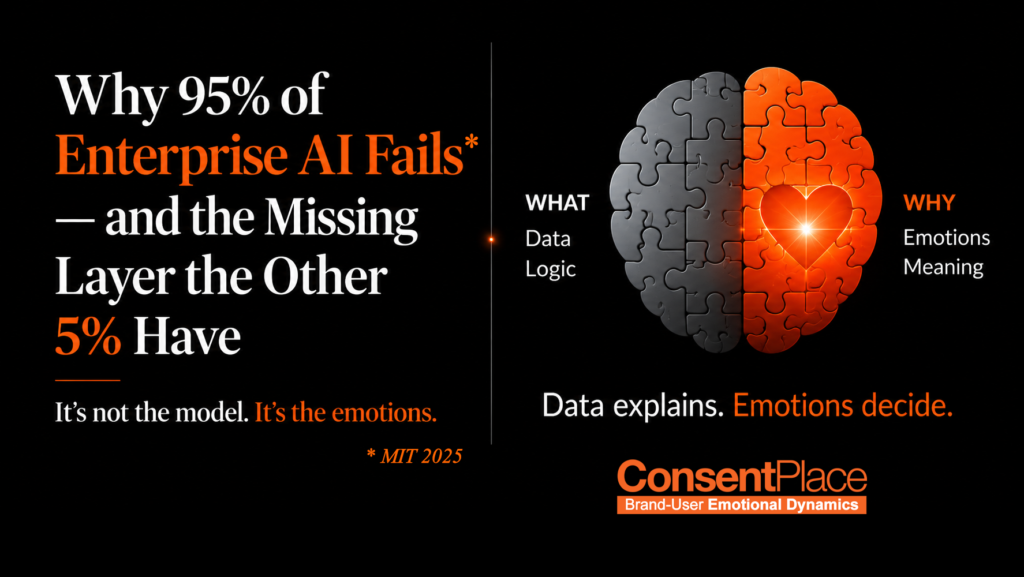
Why 95% of enterprise AI fails — and the missing layer the other 5% have.
Personalization is 30 years old. The Why behind every interaction is not. Neither is the How. And neither is the Reception — the layer that decides whether AI lands or quietly fails.
In 2025, MIT found that 95% of enterprise generative AI deployments fail to deliver measurable P&L value. Gartner predicts over 40% of agentic AI projects will be canceled by 2027. The failure mode is not model capability. The models work. The infrastructure scales. The investment is there.
What’s failing is reception — the layer between technically correct AI output and the human receiving it. The 5% that succeed have built an emotional infrastructure layer, whether they call it that or not. The 95% have not.
This post lays out the four functions that layer has to perform — and why ConsentPlaceAgent is the only Emotional Dynamics infrastructure layer purpose-built for it.
The numbers most enterprise AI conversations refuse to start with
In August 2025, MIT’s Project NANDA published The GenAI Divide: State of AI in Business 2025. The headline finding, drawn from interviews with 150 leaders, a survey of 350 employees, and an analysis of 300 enterprise AI deployments, was this: 95% of enterprise AI deployments fail to deliver measurable P&L value.
Despite $30–40B in enterprise generative AI investment, only 5% of pilots achieve rapid revenue acceleration. The vast majority stall — delivering little to no measurable impact on the business.
Two months earlier, Gartner had published a forecast for the next category up the stack: more than 40% of agentic AI projects will be canceled by the end of 2027 due to escalating costs, unclear business value, or inadequate risk controls.
Neither study is about model capability. The models work. The infrastructure scales. The investment is there. What’s failing is execution.
The question worth asking, before any enterprise commits the next dollar to AI infrastructure: what does the 5% have that the 95% doesn’t?
The missing layer in plain language
Generative AI deployments at enterprise scale fail for one structural reason. They are built to be technically correct. They are not built to be emotionally received.
A customer support AI that gives the factually right answer to a customer in Remorse closes the relationship. A sales AI that pushes the next-best-action to a customer in hesitation converts the hesitation into resistance. A compliance bot that delivers a privacy notice to a user in Contempt confirms their suspicion that the brand is hiding something. The output is technically correct. The reception is wrong. And the reception is what drives the P&L.
This is not a problem any model upgrade fixes. MIT’s research points to flawed enterprise integration — generic tools excel for individuals because of their flexibility, but stall in enterprise use because they don’t adapt to the workflows or the humans they serve. The capability gap MIT identifies is not what the model can do. It is what the deployment can sense, what it can respond to, and how it can adapt to the human on the other side of the conversation.
The 95% deliver technically correct AI into emotional moments that cannot receive it.
The 5% adapt to who’s on the other side.
That is an emotional context gap. It is also a measurement gap, a routing gap, and a consent gap. Together, they define the missing layer.
Why this becomes more urgent, not less, as AI gets better
In April 2026, Anthropic’s interpretability team published Emotion concepts and their function in a large language model. The paper analyzed how large language models internally represent emotional concepts and found that the functional emotional representations inside the model are organized in a structure that echoes the kind of structured emotional taxonomy Plutchik’s psychoevolutionary model describes. More importantly, the paper found that these emotion representations are causal — they drive model behavior in measurable, consequential ways, including behaviors relevant to AI safety.
Read this finding alongside MIT and Gartner, and a pattern emerges:
The MIT study tells us that 95% of enterprise AI deployments fail to capture value.
The Gartner study tells us that 40%+ of the next category — agentic AI — will be canceled before reaching production.
The Anthropic study tells us that emotional context is a real, functional, causal substrate inside the AI systems being deployed.
The reason enterprise AI fails is not that emotion is irrelevant to AI. The reason is that emotion is operative inside the AI and invisible in the deployment. Models have emotional context. Deployments don’t.
That is the layer that has to be built.
The four functions of an Emotional Dynamics infrastructure layer
Any enterprise AI deployment that intends to be in the 5% rather than the 95% will require an Emotional Dynamics infrastructure layer that performs four functions:
These four functions are not independent. They have to compose into a single architectural layer that sits between the model and the human, in real time, without breaking enterprise governance constraints. That is what an Emotional Dynamics infrastructure layer is.
How this connects to OpenAI’s $4B move on the deployment layer
On May 11, 2026, OpenAI announced the OpenAI Deployment Company, backed by $4B+ in investment from TPG, Bain Capital, Goldman Sachs, SoftBank, Warburg Pincus, and the major consultancies. The founding acquisition was Tomoro, a London-based AI consultancy with ~150 Forward Deployed Engineers and enterprise clients including Tesco, Virgin Atlantic, Mattel, and Red Bull.
The stated purpose: accelerate enterprise AI deployment in the same Palantir-style “embed engineers inside the customer” model that has historically separated successful deployments from stalled ones.
The Deployment Company news matters here for one reason: OpenAI itself just put $4B behind the diagnosis that deployment, not model capability, is the next enterprise battleground. The MIT and Gartner numbers are not pessimism — they are the market opportunity that an entire industry is now repositioning to address.
But deployment alone closes only part of the gap. Forward Deployed Engineers can integrate the model into the workflow. They cannot, by themselves, give the model emotional context about the human on the other side of the conversation. That requires a different layer, built on different scientific foundations, with consent as architecture rather than as compliance.
That layer is what ConsentPlace builds.
What ConsentPlace is, in one sentence
ConsentPlaceAgent is the only Emotional Dynamics infrastructure layer for enterprise AI — a real-time, consent-native API that detects, guides, and anticipates the full spectrum of human emotion across Plutchik’s 24 dyads, so that AI systems can respond to what people feel, not just what they say. Three lines of code on the existing stack. No rip-and-replace. GDPR-native architecture.
An Emotional Dynamics infrastructure layer with these four functions — detection, reception, consent, audit — is becoming a structural requirement for any enterprise AI deployment that intends to capture P&L value rather than join the 95% that don’t.
Where this leaves the enterprise AI buyer
Three questions worth asking before the next AI deployment goes to production:
If the answer to any of these is “no” or “we haven’t thought about it,” the deployment is structurally exposed to the same failure mode that has claimed 95% of generative AI pilots and is on track to claim 40% of agentic AI projects.
The 5% have an Emotional Dynamics infrastructure layer, whether they call it that or not. The 95% don’t.
Personalization was the bet of the last 30 years.
Emotional Dynamics is the bet of the next 30.
The companies that build it into their AI stack now — and the companies that acquire it instead of attempting to build it from scratch — will be the ones whose AI investments produce ROI instead of headlines about cancellation.
The only Emotional Dynamics infrastructure layer. Live now.
Three lines of code. No rip-and-replace. GDPR-native by design.
Contact Us →References & Sources
- MIT Project NANDA. The GenAI Divide: State of AI in Business 2025. Published August 2025. Lead researcher: Aditya Challapally. Coverage: Fortune CFO Daily.
- Gartner, Inc. Gartner Predicts Over 40% of Agentic AI Projects Will Be Canceled by End of 2027. Press release, June 25, 2025. Quoted: Anushree Verma, Senior Director Analyst.
- Anthropic Interpretability Team. Emotion concepts and their function in a large language model. Published April 2, 2026.
- OpenAI / Tomoro / OpenAI Deployment Company announcement, May 11, 2026.
- Plutchik, R. A General Psychoevolutionary Theory of Emotion (1980); The Nature of Emotions, American Scientist 89(4), 344–350 (2001).