
Your AI answered correctly.
The user left anyway.
Here’s why.
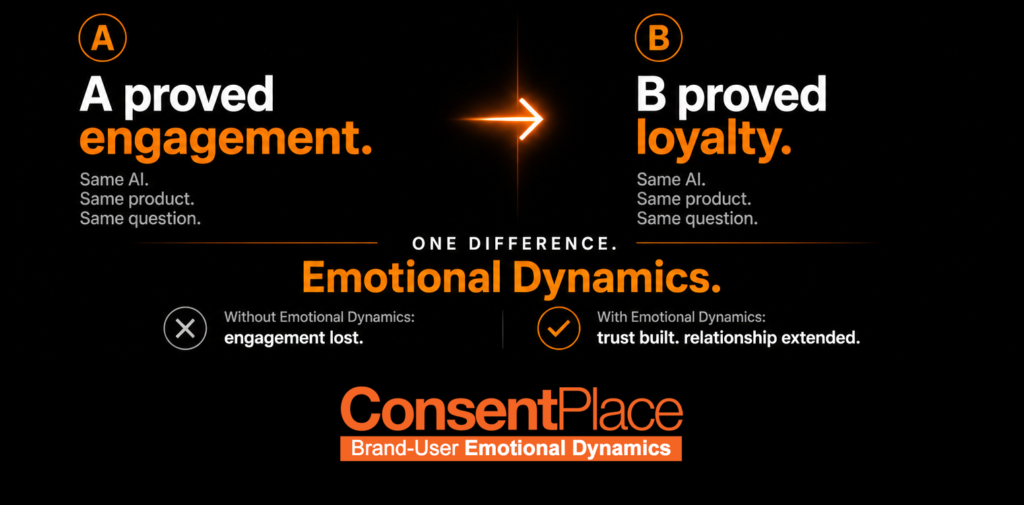
Same question. Same AI. Same product. One conversation lost. One won. The only difference: 8 instruments reading what the customer actually felt — turn by turn.
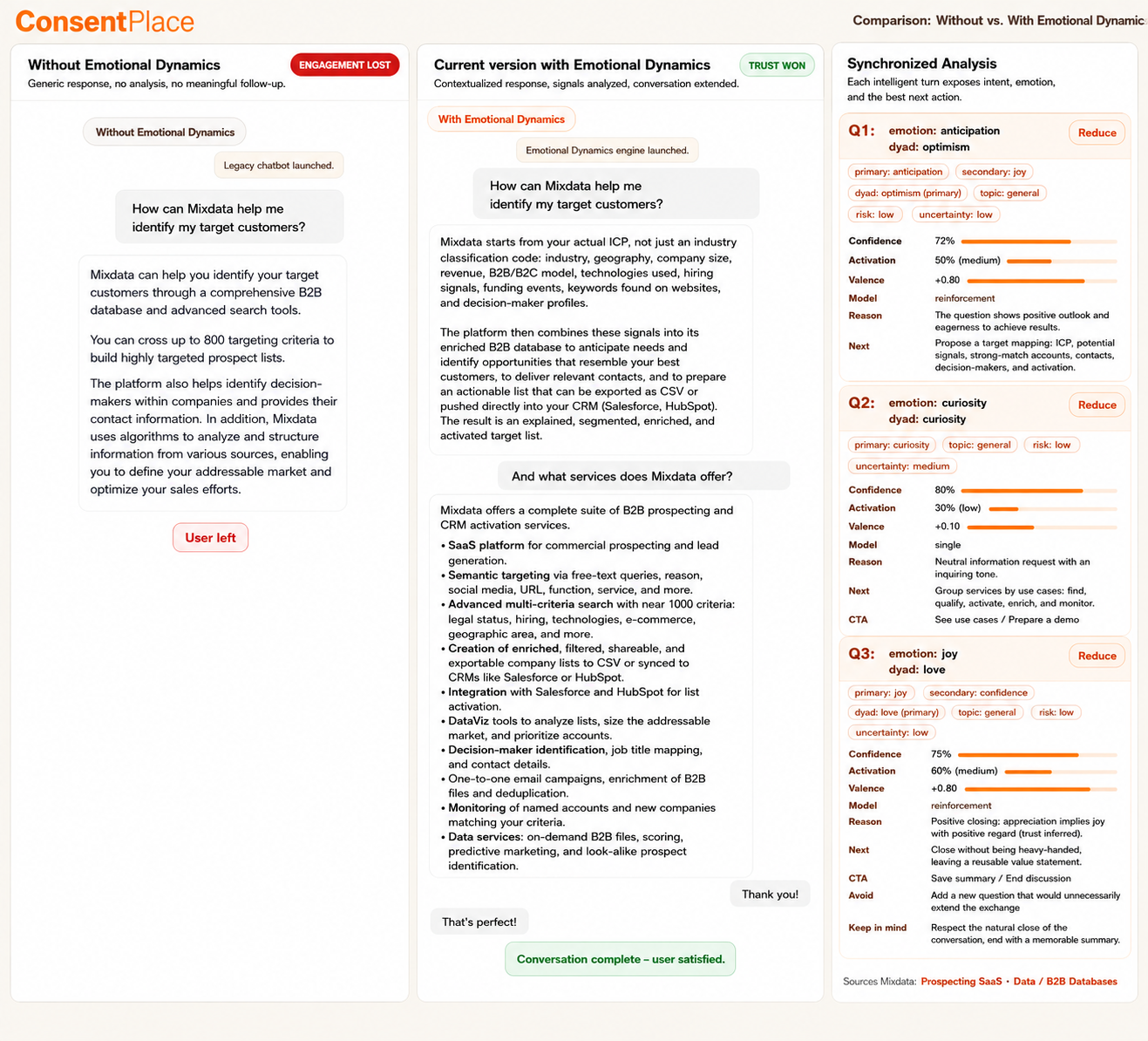
This is not a simulation. This is a real A/B test — the same AI, the same product, the same user question. Without Emotional Dynamics: engagement lost. With Emotional Dynamics: conversation won, trust built, relationship extended.
The difference is not a better script. It is a live reading of what the customer actually felt at each turn — and a response calibrated to that state, not to a generic intent category.
ConsentPlace has been building conversational AI since 2023. In May 2025 — before the Emotional Dynamics layer existed — our campaigns for Mixdata already produced results that benchmarked as “Game-Changer” against industry standards: 94.4% of email recipients started a conversation, versus a 2–5% industry average for static forms. Engaged visits at 61.11%, returning users 2–3× above norms. The conversational layer alone was already transformative.
Then in March 2026, we launched Emotional Dynamics — the layer that reads why a user is asking, not just what they asked. The A/B test below shows exactly what that addition changes. Same Mixdata client. Same AI. Same question. One conversation lost. One won.
This screenshot has been translated.
The same question. Two completely different conversations.
The user is a prospect evaluating Mixdata, a B2B data intelligence platform. The question is straightforward: “How can Mixdata help me identify my commercial target?”
Without Emotional Dynamics, the AI produces a comprehensive, accurate response — listing features, criteria, capabilities. Technically correct. Completely generic. The user reads it, gets what they needed informationally, and leaves. No follow-up question. No deeper engagement. No relationship started.
With Emotional Dynamics, something different happens. The AI detects the emotional state underneath the question — not what was asked, but why it was asked, and what the user needed to feel in order to continue. That reading changes everything.
A correct answer to the wrong emotional state
ends the conversation.
A calibrated answer to the right emotional state
starts a relationship.
Each turn of the conversation with Emotional Dynamics active shows a different capability at work — reading a different emotional signal and adapting the response accordingly. Here is exactly what the system detected, and what it did.
What this A/B test actually proves
This is not a test of which AI writes better copy. The content of both responses is accurate. The product is the same. The user question is identical. What changes is the emotional intelligence layer — and that single change produces an entirely different outcome.
Without Emotional Dynamics, the AI optimizes for correctness. It answers the question. It provides value. And the user leaves — because information without emotional calibration does not create a reason to continue. It creates a reason to stop. The question has been answered. There is nothing left to do.
With Emotional Dynamics, the AI optimizes for the state behind the question. It reads Anticipation + Optimism at Q1 and responds to the vision, not the feature list. It detects Curiosity at Q2 and organizes by use case instead of piling on features. It recognizes Joy at Q3 and understands the relationship has crossed a threshold. Three turns. Three different emotional states. Three different calibrated responses. One conversation won.
All figures from ConsentPlace campaigns (May 2025) — before the Emotional Dynamics layer. Rated “Game-Changer” and “Outstanding” vs. B2B industry benchmarks by ChatGPT analysis. The A/B test in this post shows what Emotional Dynamics adds on top of these already exceptional baselines.
Why this is a no-brainer for any enterprise AI stack
Every enterprise AI deployment today has the same gap. The AI is correct. The AI is fast. The AI is available. And users still leave, still churn, still fail to convert — because correct answers delivered to the wrong emotional state do not produce engagement. They produce closure.
The A/B test above shows this with a single conversation. The campaign numbers show it at scale. The pattern is identical: when the AI reads what the user actually feels — not just what they typed — the conversation continues. When it does not, the conversation ends.
ConsentPlaceAgent is three lines of code on your existing AI stack. No rip-and-replace. No retraining. No new interface. It adds the emotional reading layer that turns correct AI responses into conversations that build trust, extend engagement, and prevent the silent churn that no CSAT score will ever catch.
Data tells you what the customer asked.
Emotional Dynamics tells you why they asked it.
The 8 instruments tell you exactly what to do next.
This is what that looks like — turn by turn.
See the difference in your own conversations.
ConsentPlaceAgent is live. Three lines of code. No rip-and-replace. Built on Plutchik.
Contact Us →References & Sources
- Recent Emailing & LinkedIn Ads Campaigns Show Stellar Engagement for ConsentPlace — ConsentPlace Blog, May 2025. The campaign results that proved conversational AI outperforms static forms — before Emotional Dynamics was added.
- ConsentPlace campaign results (2025–2026). Email campaigns: 94.4% conversations started, 22.22% freely entered questions. LinkedIn Ads: 145.28% conversations started, 9.43% freely entered questions. Industry benchmark for static forms: 2–5% engagement rate.
- Turning Clicks into Conversations: Why ConsentPlace is a Game-Changer for B2B Brands — ConsentPlace Blog.
- Anthropic Interpretability Team (April 2, 2026). Emotion concepts and their function in a large language model. Emotional representations confirmed inside LLMs, in a structure echoing Plutchik’s psychoevolutionary model.
- Plutchik, R. (1980). “A general psychoevolutionary theory of emotion.” — (2001). “The Nature of Emotions.” American Scientist, 89(4), 344–350.
- The customer didn’t complain. Didn’t escalate. Just quietly decided to leave. — ConsentPlace Blog, May 2026.
- Data told you What. Emotional Dynamics tells you Why. — ConsentPlace Blog, May 2026.
- Past. Present. Plug in. — ConsentPlace Blog, May 2026.