
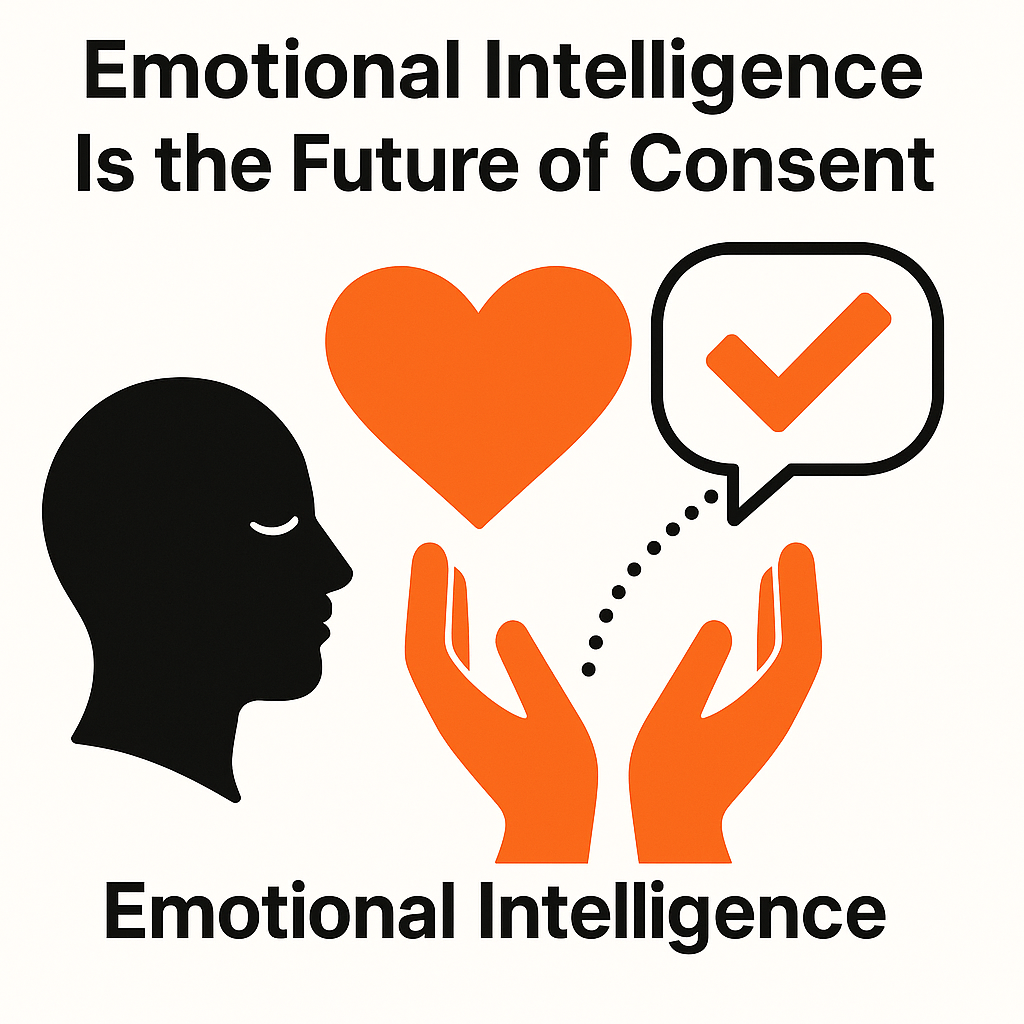
For years, digital consent has been treated as a legal requirement, a UX hurdle, or a compliance checkbox. But something fundamental has changed in the way people interact with brands:
Consent is no longer a formality.
Consent is an emotional decision.
In a world where stress, confusion, and information overload shape every digital interaction, asking for consent without understanding emotional context is not just ineffective — it’s disrespectful.
Users aren’t disengaging because they dislike sharing data.
They disengage because they feel misunderstood, pressured, or unseen.
This is where Emotional Intelligence becomes the missing foundation of meaningful, ethical, and sustainable consent.
1. Consent Begins With Emotional Trust — Not Legal Text.
Traditional tools assume that clarity and compliance are enough.
They aren’t.
If a user is skeptical, rushed, anxious, or simply confused, the same consent request will be interpreted in completely different ways.
The question isn’t:
“Did we explain the terms correctly?”
The real question is:
“Did the user feel understood, respected, and in control?”
Consent without emotional alignment is not true consent.
It’s friction — and it erodes trust.
ConsentPlace changes this by recognizing emotional signals in real time and adapting the conversation accordingly.
2. Emotional Intelligence Respects User Agency.
When a user interacts with a form or chatbot, they bring:
- their emotional state,
- their cognitive load,
- their expectations,
- their fears,
- their cultural context,
- their level of knowledge.
Ignoring these factors creates power imbalance, even if the legal framework is correct.
ConsentPlace brings balance back.
With Emotional Intelligence, the system doesn’t just collect permission — it earns it:
- anxious users receive reassurance,
- confused users get clear explanations,
- skeptical users receive transparency,
- curious users get depth and detail.
Every response respects the user’s state of mind.
This is what consent should have always been.
3. Emotional Intelligence Creates a Shared Understanding.
ConsentPlace’s conversational engine listens, interprets, and adapts — not to influence, but to ensure intention is aligned on both sides.
This is the first time consent becomes a relationship, not a transaction.
Emotional Intelligence transforms:
- “We need your permission” into
- “We want to make sure you feel confident in your choice.”
It transforms:
- “Click here to accept” into
- “Here’s what this means for you, in your language, in your context.”
This is how emotional clarity becomes ethical clarity.
4. Emotional Intelligence Makes Consent Transparent and Empowering.
Consent often fails because users don’t feel equipped to make a decision.
Emotional Intelligence fixes this by:
- simplifying complexity for overwhelmed users,
- providing nuance for high-intent users,
- adapting tone and pacing,
- surfacing the information that matters most to that person,
- building a space where questions are welcome and valued.
ConsentPlace becomes the first platform where consent isn’t extracted — it is co-constructed.
This shift is not cosmetic.
It’s structural.
It’s ethical.
It’s long overdue.
5. Emotional Intelligence Future-Proofs Privacy & Data Relationships.
As third-party data collapses and regulation tightens, every brand must answer:
How will we build trust when users no longer owe us anything?
The answer is simple:
👉 by understanding them
👉 by respecting their emotions
👉 by earning their trust through empathy, clarity, and relevance
👉 by treating consent as a conversation, not a contract
This is what ConsentPlace delivers:
- explicit, meaningful consent
- emotional transparency
- user-driven choice
- trust built one conversation at a time
Emotional Intelligence is not an enhancement.
It is the foundation of the future of consent.
The Bottom Line:
Consent without Emotional Intelligence is mechanical.
Consent with Emotional Intelligence is meaningful.
The brands that win will not be those who push the most forms or optimize the most checkboxes.
They will be those who:
- listen,
- adapt,
- respond with empathy,
- and make users feel safe, respected, and understood.
ConsentPlace wasn’t built to optimize consent.
It was built to honor it — through Emotional Intelligence at scale.
This is the future of privacy.
This is the future of trust.
This is the future of digital relationships.
This is the future of consent.
And it starts now.