
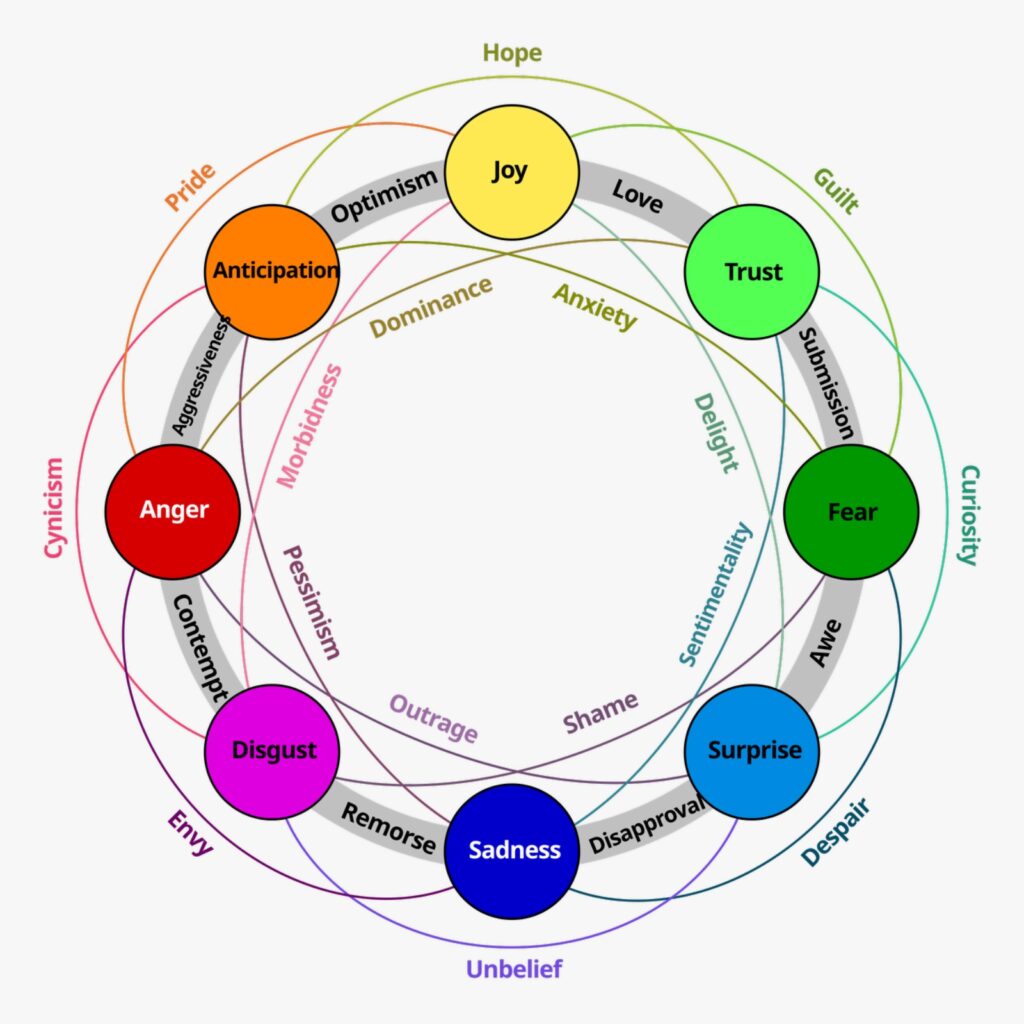
Earlier this month, we shared why Plutchik’s Wheel of Emotions is the cornerstone of ConsentPlace’s Emotional Intelligence model – and beyond..
This week, we’re going one level deeper — because the real story isn’t the wheel itself.
The real story is what the wheel makes possible: Emotional Dynamics.
And within it, the most powerful concept for brands today: Dyads.
This is not theoretical psychology.
This is the next operating system of trust.
The new reality: brands don’t compete on products — they compete on trust.
Most categories are now crowded.
Pricing is transparent.
Features can be copied.
Distribution is instant.
In 2026, differentiation increasingly comes down to one thing: How your brand makes people feel when they interact with you.
Not your tagline.
Not your brand book.
Not your ads.
Your experience.
And the experience is now shaped by AI, automation, and human-machine interactions — at scale.
That’s why Emotional Intelligence isn’t “nice to have” anymore.
It’s mandatory.
Why traditional CX and marketing systems are structurally blind.
Most customer engagement tools were built to optimize behavior:
- what users clicked
- where they dropped
- what converted
- what didn’t
That’s useful. But it’s incomplete.
Because every meaningful decision is emotional:
- “Do I trust them?”
- “Do I feel safe?”
- “Is this worth my time?”
- “Am I being manipulated?”
- “Do I regret this already?”
When systems can’t read emotional context, they respond with generic flows.
That’s when brands lose people.
Not because the product is bad.
Because the interaction feels wrong.
The dyad breakthrough: humans rarely feel one emotion at a time.
Here’s the uncomfortable truth most platforms ignore: Customers almost never experience a single isolated emotion.
They experience blends.
Confidence mixed with doubt.
Curiosity mixed with fear.
Trust mixed with hesitation.
This is exactly what Plutchik’s model reveals through Dyads: predictable combinations of emotions that create higher-order states.
This is where Emotional Intelligence becomes something more powerful: Emotional Dynamics — the ability to understand emotional interactions, not just emotional labels.
Why dyads matter more than “positive vs negative”.
Most systems classify emotion at the surface level:
✅ positive
❌ negative
😐 neutral
But dyads reveal why someone is moving forward or pulling back.
Primary Dyads (adjacent emotions)
These are the strongest, most stable blends — the states where trust is naturally built.
Example:
- Joy + Trust → Love
- Anticipation + Joy → Optimism
Brand implication: these are moments of alignment.
Your job is to protect momentum.
Secondary Dyads (one step apart)
These blends create tension and ambivalence — where decisions slow down.
Example:
- Trust + Surprise → Curiosity
- Joy + Fear → Guilt
Brand implication: these are decision moments.
Your job is to clarify, reassure, and guide — without pushing.
Tertiary Dyads (distant/opposites)
Rare, conflicted combinations that often look “neutral” to basic AI.
Example:
- Joy + Sadness → Bittersweet
- Trust + Disgust → emotional blockage
Brand implication: these signal instability.
Your job is to slow down and restore clarity, not accelerate conversion.
This is why Emotional Dynamics becomes mandatory.
If your brand engages users at scale through automation, AI assistants, flows, chatbots, or funnels…
Then you’re already influencing decisions in moments of uncertainty.
And that means your systems must be able to do one thing reliably: distinguish alignment from hesitation and hesitation from resistance
Because the wrong response creates:
- pushiness when users need reassurance
- overwhelm when users need clarity
- friction when users need confidence
- distrust when users need control
In 2026, that’s not a UX issue.
That’s lost revenue, lost reputation, and lost long-term trust.
Why only ConsentPlace can deliver this level of intelligence.
Many companies claim “emotional AI.”
Most of it is either:
- sentiment detection
- scripted empathy
- tone matching
- generic conversational UX
But dyads require something far more advanced.
ConsentPlace is not trying to detect emotions.
ConsentPlace is designed to understand emotional interactions in real time — and translate them into trust-building conversations and strategic insight.
ConsentPlace delivers what others can’t:
1) Emotional Dynamics at the point of decision
Not after the drop-off.
Not in a survey.
Not in a dashboard weeks later.
In the moment.
2) Conversations that adapt without manipulation
Dyads allow adaptation with respect — not pressure.
This is what makes ConsentPlace ethical by design.
3) Intelligence that brands can act on
Not just “users were negative.”
But why, where, and how emotional patterns shift — so teams can improve experience, trust, and conversion sustainably.
The strategic shift: from conversion optimization to trust engineering.
The best brands won’t win by pushing harder.
They’ll win by understanding better.
In a world overloaded with AI-generated content and automated touchpoints, human attention will go where trust is highest.
And trust is built when people feel:
- understood
- respected
- in control
- guided at the right pace
That requires Emotional Dynamics.
Not in theory.
In systems.
The bottom line:
Dyads are the language of real decisions.
And Emotional Dynamics is how brands earn trust in 2026.
Plutchik’s wheel gave the map.
ConsentPlace built the engine.
Because the future of brand-user relationships will be direct, conversational, and emotionally intelligent —
or they won’t exist at all.
Questions?
This is a really fascinating perspective! It’s great to see how brands are starting to focus on these deeper emotional connections.