
For years, marketing has revolved around data — clicks, conversions, and algorithms designed to predict behavior.
But as the industry became more analytical, it also became more mechanical.
We learned what people do, but forgot why they do it.
The next evolution isn’t about collecting more data — it’s about understanding emotion.
Because emotions are the original data: the most reliable signals of human intent.
In our earlier post, “Why Conversations Outperform Forms — Every Time”, we explained that real conversation captures nuance that forms can’t.
Now, we take that further: emotions are not noise to be filtered out — they are the very drivers of choice.
The Emotional Shift
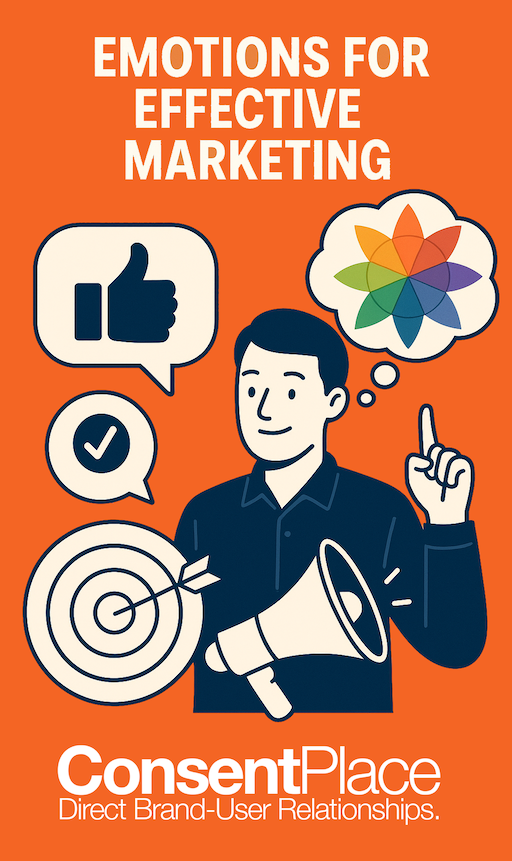
Plutchik’s psychoevolutionary theory shows that emotions evolved as adaptive behaviors — helping us decide, connect, and survive.
Fear protects us. Joy unites us. Trust sustains us.
And in marketing, those same emotions still determine who we trust, what we buy, and which brands we invite into our lives.
As we wrote in “The 5 Levels of Empathy in ConsentPlace’s Empathy Engine”, empathy isn’t a single moment — it’s a progression.
Brands that understand and respond to emotional cues move from simple interaction to authentic relationship.
Where Emotional Meets Conversational Intelligence
At ConsentPlace, we’ve fused two powerful dimensions:
- Emotional Intelligence for Users — understanding how people feel and why they consent.
- Conversational Intelligence for Brands — adjusting tone, timing, and empathy dynamically, in real time.
Together, they create Direct Brand-User Relationships — not based on tracking or targeting, but on mutual understanding.
As we shared in “Our Mission: Direct Brand-User Relationships”, this is not more MarTech — it’s CustTech: customer-first technology grounded in ethics and empathy.
The New Marketing Metric
Clicks and conversions measure what people do.
But emotional signals reveal why.
And that’s the difference between optimizing a transaction and cultivating a relationship.
In “Explicit Consents R Us!”, we showed how explicit consent builds the foundation of trust.
Today, that trust expands into emotional awareness — measuring shifts in anticipation, confidence, and connection.
These are the real KPIs of tomorrow’s marketing.
The Human Return on Emotion
Emotionally intelligent marketing isn’t about manipulating feelings — it’s about honoring them.
Plutchik’s work reminds us that emotions are adaptive, purposeful, and deeply human.
By reading and responding to them ethically, brands don’t just perform better — they become more trusted, more relevant, and more human.
The future of marketing goes beyond data —
toward empathy, understanding, and connection.
That’s the real ROI of emotion:
Relationships Over Impressions.
Empathy Over Efficiency.
Trust Over Targeting
Makes sense? Contact us!
I love how this shifts the focus from data to emotion, and understanding why people act matters more than just tracking clicks. It feels warm and hopeful to see marketing move toward emotional intelligence.